Trey Finley’s comment on my last post made me feel like a dick.

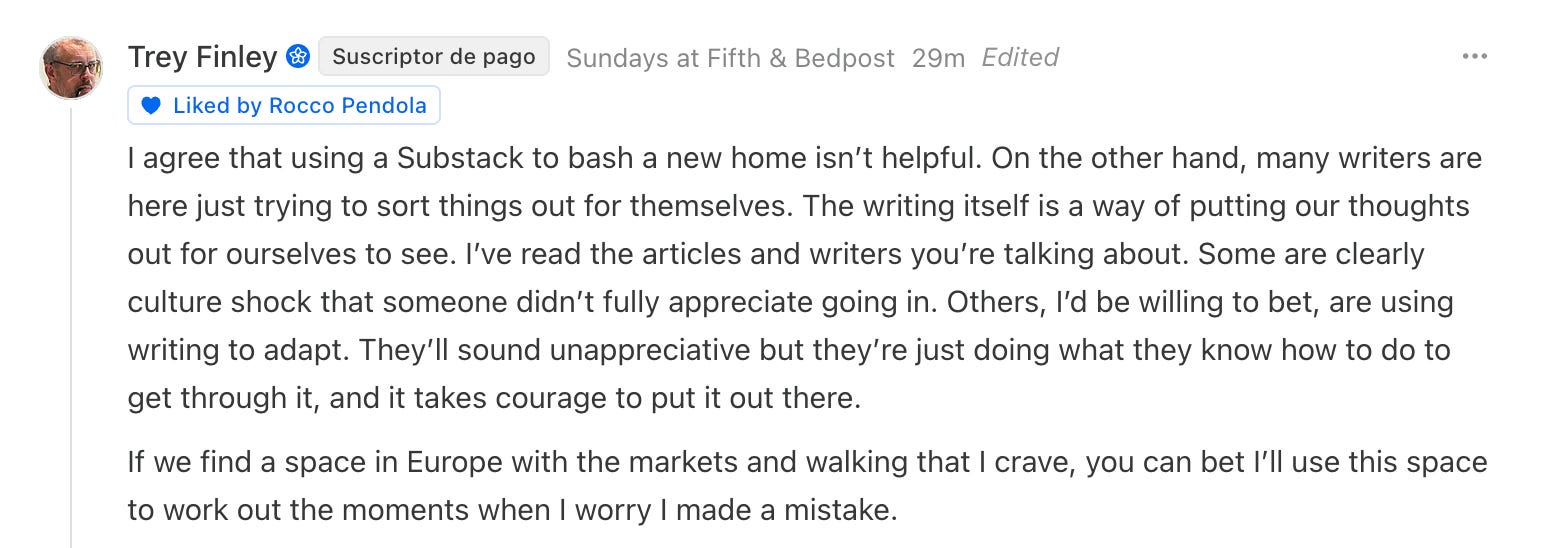
Point well taken.
As I noted in a reply to Trey, “the problem isn't with individuals as much as with the collective environment all of these individuals combine to produce. I feel like I go out of my way to make that point.”
I almost always start with things that a meaningful number of individuals say. Things that have been said so many times that they’ve been accepted as fact or, at least, an objective version of reality. But—in my experience—they’re untrue and more a reflection of individuals projecting whatever unease or discomfort they’re experiencing onto an entire culture or country. It’s not as if I haven’t caught myself doing just this in all sorts of life situations.
At this juncture, we have a real problem that doesn’t receive enough attention.
Writing as you experience some form of culture shock is not the same thing as reporting on a culture. Most of us who write for fun—or for a living—write to talk through things. For as much as I feel like I’ve remained consistent on the larger themes pre-move and post-move, I’ve definitely changed what I write about and how I write as I navigate life in Spain.
There’s nothing wrong with that. In fact, it’s good.
I also appreciate Trey’s comment because—I presume—he was a little annoyed when he wrote it, but he presented his thoughts in a way that helps advance and add nuance to the conversation. A dynamic often absent in general discourse these days as well as this specific moving abroad conversation.
Someone can write something emotionally honest and factually wrong. This doesn’t invalidate their discomfort, fear, loneliness, or whatever is going on. Those feelings are real. Their worry that they made a mistake is real. But their explanation for those feelings might be completely wrong.
If you’re struggling with something, I think you should write about it. However you choose to go about it, that belongs to you. But “Spain is slow, inconvenient, and unresponsive” is a claim about a country, its people, and its institutions.
This is where a sense of personal clarity—if not responsibility—needs to enter the picture.
Are you complaining about doing laundry, using a small oven, or needing the right paperwork—or is something bigger going on? Because—as I tell my wife every single time our kitchen sink clogs up—if this is all I have to deal with, I’m one pretty lucky guy.
Minor inconvenience is part of life. I really think a lot of it does come down to city versus suburban living. Dealing with apartment quirks isn’t an inconvenience to me. It’s just how it is—and beats the hell out of true inconvenience like having to drive 20 minutes to go less than two miles.
Maybe there’s no association between urban quirkiness and perceived suburban convenience, but enough Americans have a warped sense of what city life as day-to-day life actually looks and feel like that I think there’s something there, particularly when these Americans plop themselves in an urban environment, in a different country.
There’s an analogy here between people who do yoga at room temperature and those who do Bikram Yoga with 104-degree Fahrenheit heat and 40% humidity. To me the heat and humidity isn’t a problem to be solved, it’s part of the somewhat demented joy and the glaring and never-ending challenge of the process.
I really believe people have fundamentally different relationships to discomfort and that there are many different types, different levels of complainers. Those folks who despise density and those who crave and thrive on it. Those who would never—who think it’s crazy—to enter an extremely hot and humid room to exercise and those who can’t wait to go back in. I think the people who invite environmental attributes such as density, heat, and humidity might be more prone to seeing city life not merely as charming in theory, but the only way they feel like they can do life in practice.
It’s the difference between a little discomfort—a departure from what you’re used to—and real pain—which often feels like what many “expats” are expressing when they complain about how “inconvenient” life is in Italy, France, Spain, or wherever.
Do they realize how good they’ve got it?
I’m busy working my ass off to enjoy and keep this life as full and alive as possible. I don’t have the time or inclination to complain about what’s missing or go on a hunt for American food products.
People sometimes choose another country as though they’re accepting a new job. They compare the benefits, imagine the improved lifestyle, arrive expecting some form of onboarding, and then evaluate whether the “culture” suits them. If it doesn’t, they effectively write a Glassdoor review of Spain.
They fail to realize that Spain—or wherever they’re living—was a society already in progress before they arrived and it will remain a society in progress long after they leave.
That said, the standard cannot be that somebody should know exactly how moving will feel. Nobody can, and demanding this would make my argument unfair. But there’s considerable territory between knowing exactly how a move will feel and showing up with little more than a visa and a fantasy.
I’ve spent years thinking, talking, traveling, and writing our way toward Spain. I had spent decades studying cities and living in dense urban environments. After my wife and I visited and reflected, we knew exactly why we wanted Valencia, understood what we were giving up, and approached the move as an enhancement to an already good life—not a cure for a bad one. We researched the visa, taxes, housing, healthcare, and the basic machinery of daily life.
Emotionally, we understood wherever you go, there you are so thoroughly that it never really came up. That’s another one of those things people repeat when it’s really just…life. Moving wouldn’t eliminate anxiety, work pressure, missing people, or the ordinary difficulties of being alive.
None of that meant we knew exactly how Spain would feel. It meant we arrived with a strong basis for interpreting what happened once we got here. Preparation doesn’t eliminate culture shock, but it can keep you from misidentifying every surprise as a failure of the place—and help you differentiate between pain and discomfort.
The standard should be humility about causation: when something feels difficult, ask whether the problem is Spain, city life, culture shock, inadequate preparation, personal preference, or simply the ordinary anxiety that follows any enormous decision. Is it the routine discomfort of life anywhere at any time—or genuine pain caused by something place-specific?
Sometimes it really will be Spain. Cities and institutions don’t always do things well. People can be exclusionary. I’ve made criticisms about Valencia. But I investigate and compare what I’m seeing here to what I’ve seen before and how I’ve felt at those different points before deciding what the complaint proves.
None of this makes me immune from making the same mistake in reverse.
The fact that Trey’s comment made me feel like a dick probably means that, while criticizing the collective environment, I flattened some of the individuals inside it. If I turn my overwhelmingly positive experience into evidence that everybody struggling must be unprepared, ungrateful, or wrong, I’m doing a version of what I’m accusing them of doing.
Their culture shock isn’t Spain. My largely successful adjustment isn’t Spain either. They’re different experiences taking place inside Spain.
The responsibility isn’t to arrive with every feeling anticipated and the whole experience figured out. That’s not possible. It’s to remain clear about the difference between what you’re feeling and what you think caused it. And I consider it a responsibility to investigate whether the place actually produced those feelings—or merely provided the setting where you experienced them—before writing that Spain is isolating, dysfunctional, or inconvenient.
Because if you don’t, you’re merely contributing to unproductive folklore.
Your feelings are evidence of what you’re experiencing. They aren’t necessarily evidence of what caused it.
That isn’t an argument for writing less honestly. It’s an argument for writing more precisely.
Point taken, Trey. I don’t think the larger argument was wrong. But I’m glad you pointed out what was missing because it made me think harder about what I’m thinking and saying—which is another part of the larger point here.