

Within a five-minute radius from my apartment in Valencia, I counted at least 15 laundromats.
It reminds me of San Francisco—at least when I lived there, circa 1999 to 2006.
In both cities, laundromats have both washers and dryers. Every laundromat I’ve encountered in a decent-sized city in the United States, Canada, France, Italy, or Spain has had both—and I purposely only listed places where I have firsthand experience.
In San Francisco, I didn't have a washer (or dryer, obviously) in my apartment. And even if I had, I never had a suitable place to line dry my clothes.
In Central Los Angeles, where laundromats seem to outnumber bicycles, my wife had this now-legendary, but pretty lame portable washing machine that we'd have to awkwardly wheel out of the closet and hook up to the kitchen faucet, breaking the terms of our lease. We dried our clothes on a rack in front of a window. Sometimes they'd take more than 24 hours to dry.
It got to the point where it was just easier to go to the laundromat if we had more than a small load or if our landlord seemed suspicious.
In large cities in the US, in-unit washers and dryers are luxury amenities for many renters. They actually add to the cost of rent.
In urban Spain, you’ll typically find a washer in the kitchen or, as is the case in our apartment, inside a closet on the back terrace. We dry our clothes on plentiful outdoor clotheslines just like almost all of our neighbors.
In suburban or otherwise low-density, “apartment complex” type settings in the US, many people have a washer and dryer in their home. If not, they often throw their clothes in the backseat of their car and “do their laundry” at their parents’ house.
I'm merely detailing cultural and geographic differences. While I like to think I add at lrast a little something to the conversation, who really cares? The last thing we need is another person who moved talking about the way they do laundry in Spain. Like they got the idea to move from Good Housekeeping magazine.
Plus, I’m a little weird. I like doing laundry—and other household chores. I prefer doing the laundry here.
And pursuant to our conversation earlier this week—I think many people who lead with laundry and mindlessly repeat this myth that life in Spain—relative to the US—is inconvenient are suburbanites or low-density apartment complex dwellers.
Many of them only know the experience of having a washer and dryer in their home. They've never lived in a city where this isn't the norm. So they turn up in Spain—with noisy suitcases and white jeans—and say it's inconvenient when, in reality, it's just city life. In fact, doing your laundry in urban Spain tends to take fewer steps than doing it in the few American cities that still function relatively well as dense urban cores.

After Tuesday’s post, a reader left the following comment:
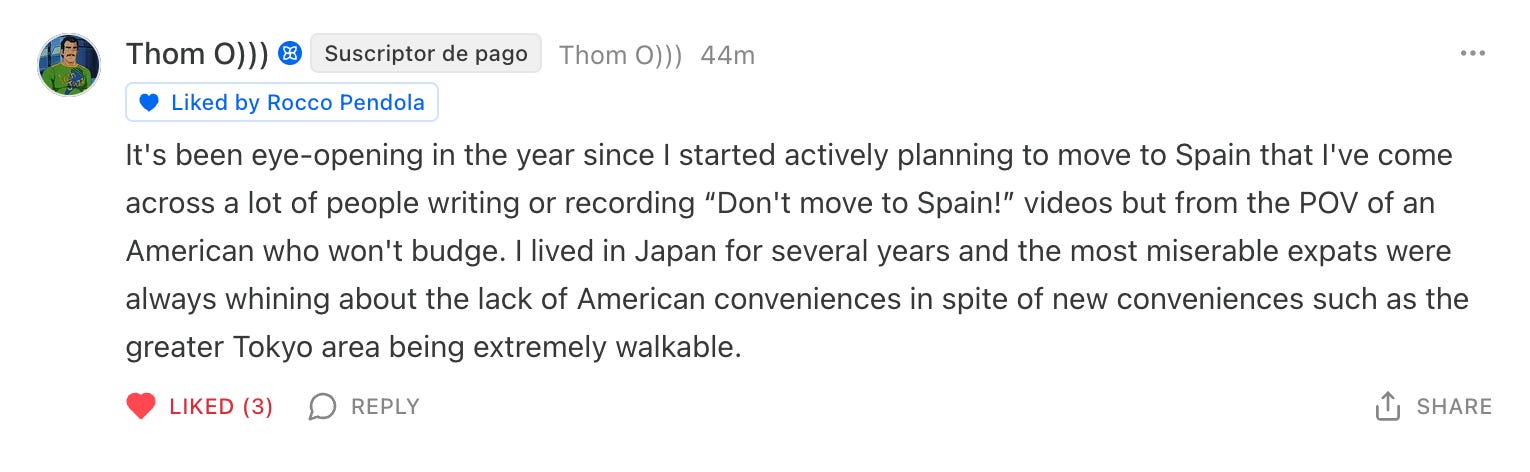
On Notes, I replied with:
It’s incredibly unfortunate.
I’m doing my best to counter it.
I feel like I used to feel as an urban cyclist in the United States.
That last line has a dual meaning.
But the best introduction to what follows is that my instinctive reaction to a majority of the complaints I hear Americans make about life in Spain—particularly urban Spain—is:
Haven’t you ever lived in a city before?
More often than not, the answer is no—or they lived somewhere legally classified as a city, not in a genuinely dense urban environment.
As far as the urban cyclist analogy goes, in the move abroad discourse I feel like that one cyclist navigating through a sea of motorists who, if they even notice I’m there, treat me like an obstacle.
The second meaning goes deeper.
In both situations, the majority mistakes a system designed around its preferences for the natural—and righteous—order of things. Motorists don’t see the traffic lanes, parking spaces, signals, gas stations, drive-throughs, and public money required to position driving and make it feel like the natural way of life. They see the cyclist—the one person operating outside that system—as the obstacle that needs to stay out of the way.
The same thing happens in move-abroad discourse. Many Americans don’t see the physical, economic, and cultural machine required to make their version of convenience feel natural. They notice only when familiar components are missing, then treat that absence as a Spain-specific problem.
People no longer blink when Americans who have moved abroad hang onto their American tendencies and attitudes and brand their host country inconvenient. They say things about people and institutions—that they’re slow, they never respond, the bureaucracy is terrible—that are flat-out false and borderline offensive. Much of the audience accepts these claims as fact.
I think this shit slides because it has taken on a life of its own. People repeat what they hear because it sounds familiar, and familiarity easily passes for truth. Agreement also becomes a form of social desirability and currency—a form of belonging. Repeating the accepted complaints signals that you’ve been here long enough to understand what life in Spain is really like—even when you’re simply repeating something somebody else said.
The echo chamber spreads such nonsense, which quickly becomes folklore.
Spain is slow. Nobody responds. The bureaucracy is terrible. Nobody owns a dryer. Life is inconvenient.
After a while, nobody feels obligated to establish whether any of this is actually true. These have simply become the things people say. And when seemingly everybody says them, they must be true.
Repeat a claim often enough and somebody whose actual experience contradicts it starts wondering if they’re the crazy one. It can feel like being gaslit by the expat echo chamber—not because everybody is consciously lying, but because repetition has replaced evidence.
You can count 15 laundromats with dryers, watch Spanish institutions respond and act, and solve administrative problems in hours—only to be told that Spain has no dryers, nobody responds, and the bureaucracy doesn’t work.
So we’re reduced to hearing about how inconvenient life is—something these “expats” have had to “get used to”—alongside tutorials on getting visas, keeping your US phone number, and finding the one acceptable version of ranch dressing, peanut butter, or some other American junk food. The funny thing is that the exact products from back home are actually usually painfully easy to find and, when they aren’t, the local alternatives are almost always higher quality and taste better. (Four words in a row ending in -y is worth the price of a subscription.)
But I’m not interested in repeating the same old tired lines so I can fit into this strange “expat” content community. I’m out here trying to counter the nonsense with some nuance.
I’m not trying to defend Spain from criticism. I complain all the time. I just want the complaint to be true—not presented as a uniquely Spanish problem.
That requires going several layers deeper than accepting Spain is inconvenient at face value. Who considers it inconvenient? Where did they live before? What did they expect? Are they actually describing Spain—or are they describing the discomfort of discovering that the suburban American way of organizing everyday life isn’t universal?
That seems to piss some people off. Fine. But there’s a difference between examining life abroad and producing another version of the same shallow content that created the folklore in the first place.
Laundry is only the easiest example.
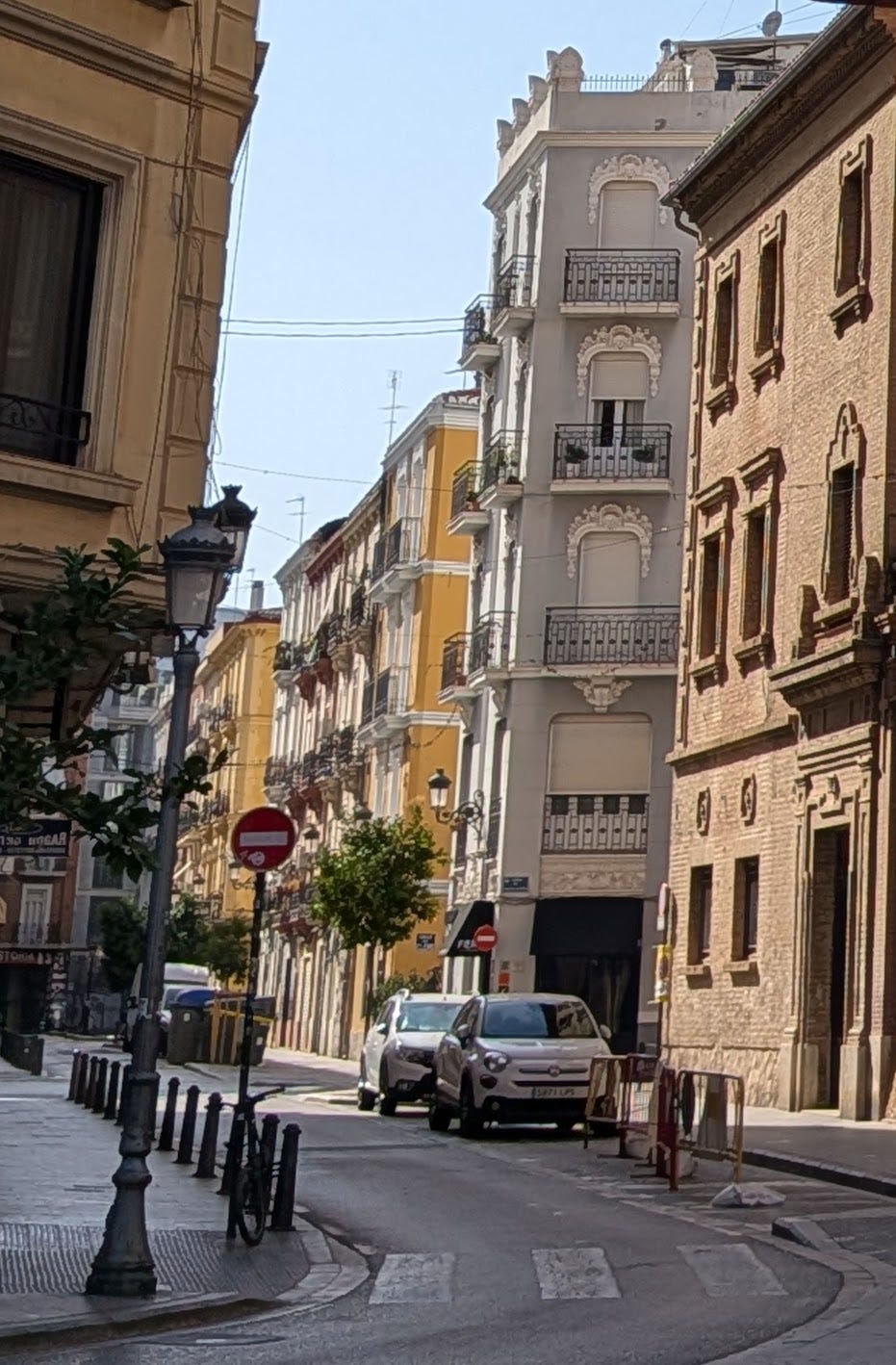
Americans tend to turn ordinary Spanish city life into exotic spectacle. Eating dinner later, buying only what you need for the next day or two, hanging clothes outside, and stopping at several nearby shops aren’t quirky rituals performed for newcomers. They’re just life—really city life in many cities around the world where it still exists in its pure form. But move-abroad content packages lifestyle as a set of adorable novelties—or inconveniences one must bravely learn to tolerate.
And it sells because Americans come from a country that fetishizes simulations of urban life—places like Downtown Disney and sterile “main streets” you have to drive to.
The fixation on apartment size—often expressed as a complaint—exposes the suburban operating system. People want the historic neighborhood, balcony, market, cafés, and plazas, but judge the apartment against a home designed to contain everything privately: laundry room, storage, enormous refrigerator, garage, entertainment space. They want city life outside and suburbia inside—and bemoan not being able to fit all the shit they brought from the US in their closets, even though they claim on social media to have only moved with three suitcases and two backpacks.
Then there’s what actually makes an urban neighborhood great: nearly 24/7 activity. Not sensory stimulation for its own sake, but the sights, sounds, and smells of people living their lives in safe, looked-after, well-functioning urban neighborhoods. Cooking smells, constant bar and restaurant chatter, garbage trucks, delivery trucks, street cleaning, neighbors talking, people coming home late, and businesses preparing to open early and slamming their gates and recycling their bottles as they close late.
If all of that registers primarily as a defect rather than vibrancy, you must hate the sound of your own heartbeat. Urban activity—often starting around 6 a.m. and going strong to at least 2 a.m. (later on weekends and holidays) is evidence that the city is alive and well.
Many Americans move to Spain for “so much life,” then complain that life talks, cooks, smells, makes deliveries, and produces garbage. Density makes the city life people say they crave possible—from the walkability to the crowded terraces and abundant local commerce.
If you can’t get used to these things—if you constantly complain about them or treat them as weird, exotic, or defective—you don’t have a problem with Spain. You have a problem with cities—or, at minimum, a lack of familiarity with and experience in them.
There’s nothing wrong with preferring suburbia.
If you want a private laundry room, enormous refrigerator, extra storage, quiet street, and the ability to complete most daily tasks privately, go for it.
But don’t move to a dense Spanish neighborhood and turn the absence of that life into a national defect. The clotheslines, smaller apartments, daily shopping, smells, noise, deliveries, and garbage trucks aren’t evidence that Spain is charming until you actually have to live here.
Your reaction to these things might reveal that you don’t like cities nearly as much as you thought you did.
Maybe Spain isn’t inconvenient. Maybe you just prefer the suburbs.
I agree that using a Substack to bash a new home isn’t helpful. On the other hand, many writers are here just trying to sort things out for themselves. The writing itself is a way of putting our thoughts out for ourselves to see. I’ve read the articles and writers you’re talking about. Some are clearly culture shock that someone didn’t fully appreciate going in. Others, I’d be willing to bet, are using writing to adapt. They’ll sound unappreciative but they’re just doing what they know how to do to get through it, and it takes courage to put it out there.
If we find a space in Europe with the markets and walking that I crave, you can bet I’ll use this space to work out the moments when I worry I made a mistake.
I'm in zero hurry to get older (or have my youngest move out), but I also can't wait to downsize into a smaller place.