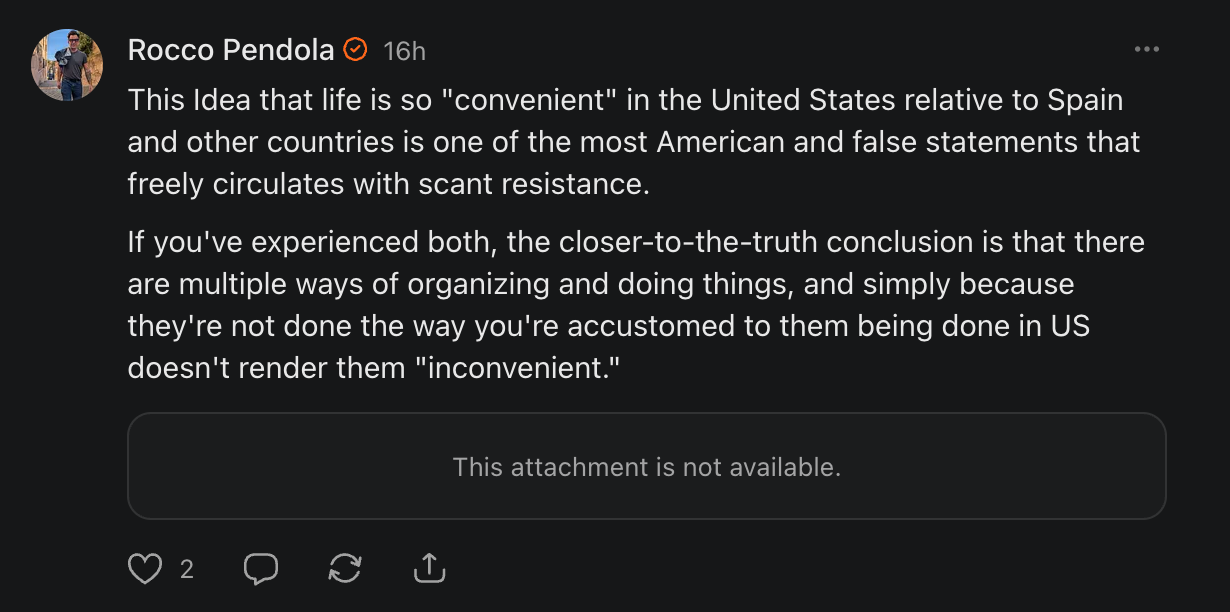
I read so many things this past weekend on Substack that illustrate the uniquely American inability to leave their attitude at the border that I almost went on a comment-leaving spree.
The problem turned out to be that I left one comment, so the algorithm bombarded my feed with more of the same, which tempted me to leave more comments. I did leave another comment on another article, promptly deleted it*, then was promptly blocked by the author. I deleted the second comment as I recalled that I do indeed have a longstanding Substack of my own and have been living in Spain—American attitude-free—for nearly two years.
I'm not one to leave comments unless they're wholly positive, encouraging, and in praise and support of consistently good work, which is why I comment regularly, for example, on Kevin Alexander’s stuff. I'm also not one to give much of a shit about other people spewing nonsense. I took Billy Joel's advice in “Angry Young Man” and stopped getting into pointless social and political debates (leaving comments) a decade or so ago now.
But this is what I do for a living. It's what I've been doing for a living for the majority of my adult life—observing, reporting, and sometimes editorializing. I'm a professional writer, not an “expat” with a blog. And I have a sweet spot of resistance to people parroting the same things they've heard others say, leading these things to circulate freely and take on unchallenged lives of their own.
Because, left unchecked, we accept nonsense as fact and lead people down false and fruitless paths. If you're moving abroad and believe half of what you read, you're going in with an inaccurate view of what's about to be your reality. Because so much of what you're reading comes not only from an American perspective, but fully colored by a quintessentially American attitude. It’s akin to a strict diet of Fox News before you enter the voting booth.
You think you know so much—and you do—but it comes from one and only one very shallow perspective and way of seeing the world. However, the thing is that you’re not actually seeing the world. You’re merely maintaining your American perspective on a world that might as well consist of only the United States—minus large cities and college towns.
What blows my mind is that some—thankfully, not most—people who move abroad often fit this description almost, if not exactly to a tee. I’m not sure I’ll ever be able to figure that one out.
What really bothered me this weekend was seeing—for the hundredth time—someone make the claim that life in Spain is “inconvenient” relative to the United States. You hear that all of the time—with things like dryers and fast food drive-throughs 100% guaranteed to enter the conversation. While that last part tells you about all you need to know, I’m going to tell you just a little bit more.
Then, we’ll chill with two new newsletter features—music that relates to what I just wrote and my attempt to translate some of what I wrote to Spanish without the help of technology or a book, or anything. The music part was inspired by a college professor who was a huge Dylan fan. He’d often begin or end—or stop in the middle of—class to ask if we just wanted to “chill” with a Dylan bootleg recording. And you know damn well that if we weren’t in that classroom we would’ve been chilling while passing a joint. The language thing is a feature I abandoned because—a year ago—I think it actually stunted my Spanish language learning progression.
Americans love to trot out the inconvenience line. And let me tell you firsthand that it’s pure unadulterated bullshit.
We’ll tackle it from two different angles.
One, more concrete. The second, more abstract, but no less true. The unifying theme here is that difference—as in, different ways of doing things—doesn’t equal inconvenient.
Concretely, I deal regularly with both the Spanish tax agency and Social Security bureaucracies. Bureaucracy, stripped of the baggage we’ve attached to the word, is simply an administrative system managed through fixed rules, clear hierarchies, and standardized procedures. We have to get that out of the way because it directly relates to the issue at hand.
In the move abroad discourse that dominates online, Americans, Brits, and a few equally entitled others have turned bureaucracy into a bad word. You don’t have the right paperwork or you do something otherwise wrong and they don’t let you complete your task. That’s good bureaucracy in action. Often, it’s the system functioning exactly as advertised. Bad bureaucracy is opaque, arbitrary, unnecessarily slow, or practically impossible to navigate.
If you’ve ever dealt with the IRS in the United States, you know it’s slow and antiquated with many basic tasks only happening over the phone or through the mail over the span of weeks, if not months. I’m in the middle of one right now. Similar issues with Spain’s tax agency take between hours and days—in person or online. When I show up early to my in-person appointments with all of my requirements in hand, I often leave before my originally scheduled appointment time.
More abstractly, you can complete life’s tasks in many different ways. Because the way you’ve become accustomed to doing something feels easy to you doesn’t make it objectively more convenient. It’s more convenient for you, but not necessarily inconvenient.
I also suspect a lot of this starts when Americans move from suburban or otherwise low-density places — where they’ve adopted a warped definition of convenience— to urban Spain, then mistake their lack of experience with city life for evidence that the city itself is inconvenient.
It’s fine to be used to doing something a certain way. It doesn’t sit well to extrapolate your comfort with one way of doing something into the claim that another way is inherently inconvenient.
That’s the American attitude. You’ve lived and done things this way for so long that you can no longer distinguish between inconvenient and different. I know it’s all fun and games, particularly at the individual level. You can probably even joke with your Spanish friends about this stuff. Nobody cares.
But it becomes a problem when you and your expat friends all move abroad with the same attitude. That attitude quickly turns into a personality trait—and ultimately distorts and disrespects reality in the country you have graced with your presence and gives your home country a bad, but well-deserved name..
I circled around this in Sunday’s post and many others—but I’ve never really had an American attitude. At least not in this context. I have always thought that the prevailing way Americans do most things is kind of dumb. Most people don’t know that dumb has a ‘b.’ I’ve been rejecting many of these things—through my words, and whenever feasible, through my actions—since about 1999 when I moved to San Francisco and… you can read details in Sunday’s post.

So — needless to say — it should come as no surprise that moving to Spain didn’t suddenly make everything even slightly different feel weird or inconvenient to me. What continues to surprise me is why so many people decide to move with entrenched American attitudes they don’t even realize they carried with them across the border. As it turns out, it’s probably that very lack of self-awareness that gives us the answer we need to make better sense of this uniquely American attitude.
They don’t think they’re carrying an American attitude abroad. They think they’re simply describing reality.
And now, something quintessentially American—in the best of ways—for us to chill to.
En español—sin ayuda
First, the original English:
I read so many things this past weekend on Substack that illustrate the uniquely American inability to leave their attitude at the border that I almost went on a comment-leaving spree.
The problem turned out to be that I left one comment, so the algorithm bombarded my feed with more of the same, which tempted me to leave more comments. I did leave another comment on another article, promptly deleted it, then was promptly blocked by the author. I deleted the second comment as I recalled that I do indeed have a longstanding Substack of my own and have been living in Spain—American attitude-free—for nearly two years.
I'm not one to leave comments unless they're wholly positive, encouraging, and in praise and support of consistently good work, which is why I comment regularly, for example, on Kevin Alexander’s stuff. I'm also not one to give much of a shit about other people spewing nonsense. I took Billy Joel's advice in “Angry Young Man” and stopped getting into pointless social and political debates (leaving comments) a decade or so ago now.
And now my attempt—without technology, a dictionary, a book, or anything else:
Leí muchas cosas de Substack el fin de semana pasado que descubrieron the uniquely American inability dejar su actitudes a la frontera que casi dejé tantos comentarios.
El problema era que dejé un comentario, así que el algorithm saturado mi feed con más de el mismo y tempted me dejar más comentarios. Dejé otro comentario en otro articulo, pero lo borré de inmediato y luego el autor me bloqueo. Borré el comentario segundo cuando recordé que tengo un Substack a mismo de largo tiempo y he estado vivido en España—sin actitud de Americano—por casi dos años.
No dejo comentarios a menos que son totalmente positivos, inspirados, y de apoyo de consecuentemente buen trabajo. Por eso, dejo comentarios con frecuencia, por ejemplo, en las obras de Kevin Alexander. También, me da igual una mierda de otras personas spewing tonterías. Tomé el consejo de Billy Joel en la canción de “Angry Young Man” and paró teniendo debates de política y social sin un punto (dejando comentarios) hace una década, más o menos.
Track Residency Risk Before It Becomes a Problem
Flamingo Compliance helps expats, and remote professionals stay on top of tax residency, visa, and residency permit requirements across multiple countries and US states. The app automatically tracks travel activity and counts days against tax and immigration thresholds, alerting users as they approach a residency trigger or visa limit. When it’s time to file or report, detailed travel reports are ready to share with tax advisors or legal professionals.
Flamingo Compliance—Tax Residency & Visa Tracking