

During the pandemic, I requested—and received—proof of my Canadian citizenship.
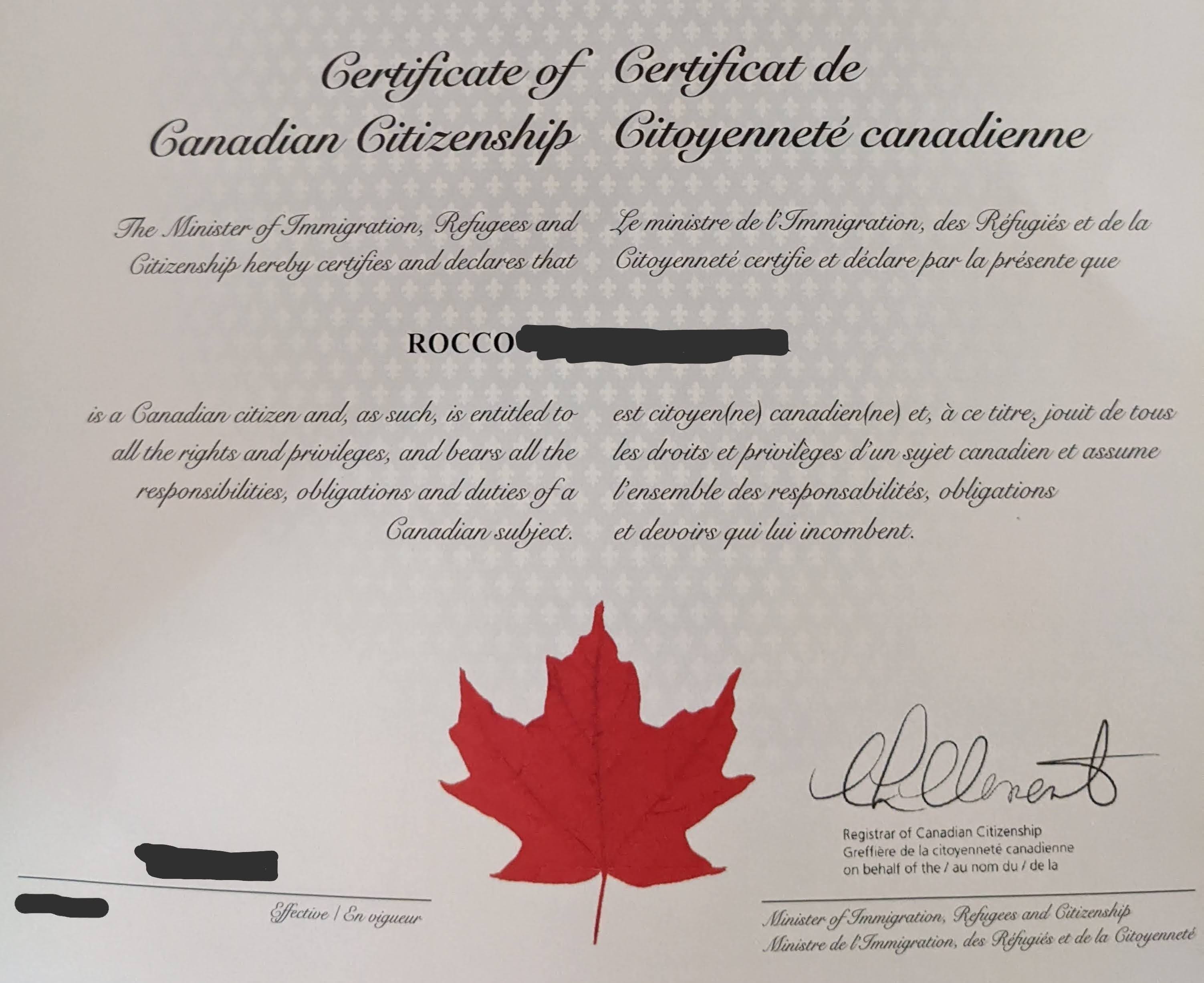
Ever since, I’ve been thinking about acquiring my Canadian passport. And—this month—encouraged by geopolitical events, primarily European Commission President Ursula von der Leyen’s proposal that Canada become the EU’s first associate member—I filled out the form and gathered everything I need for my application. I’ll send it off to the Canadian Embassy in Madrid before the end of the month.
When I was a teenager, all I knew was that my father was born in Toronto and moved to the United States when he was six months old. I was born and lived in Niagara Falls, NY—right on the US-Canada border—until the spring before my 20th birthday. So we visited often.
Plus, my grandmother was a Toronto Maple Leafs fan and my grandfather was a Montreal Canadiens fan. How that happened—I still don’t know. But both of them harbored a deep hatred for the Buffalo Sabres—and, really, all Buffalo sports teams. Especially my grandmother—who was always my favorite, so I sided with her as a child and became a “die-hard” Leafs fan.
The thing about hockey in Canada is that it’s a deep and meaningful part of the culture. It’s not enough to compare hockey in Canada to baseball in the United States or the Saturday night ritual Hockey Night in Canada to Monday Night Football.
In the United States, sports feel more like pastimes and passions for a nation with nothing better to do. In Canada, hockey might as well not even be a sport—it’s a cultural institution. Or at least it was when I was paying attention. Over the last decade, I’ve pretty much lost touch with that aspect of the nation.
It’s truly if you know, you know type stuff.
Tying things together, my first memories of fully feeling the energy of a city were in Toronto. Once in 1998 when I came to town for Ontario-born Wayne Gretzky’s final game at Maple Leaf Gardens as a member of the New York Rangers. And again—a few months later—for the final game ever at Maple Leaf Gardens. I was in my early 20s then—and that’s when I think I connected the dots for the first time.
On childhood visits to Toronto—and, to a lesser extent, Buffalo—I was always intrigued by the city. But it was akin to visiting outer space. There was never even a thought that we’d live in a place like that, rendering those who did alien others. But—somewhere in my preteen and teenager brain, I knew that these were people producing an energy I couldn’t quite begin to understand.
Shortly after those Toronto visits, I was about to experience Boston. I went there for work—for the Major League Baseball All-Star Game—in July 1999. For the week I was there I couldn’t get enough of that city. Long story short, I ended up moving to San Francisco in September 1999 after ending a temporary gig at a sports radio network in Las Vegas.
The first time I walked in the cold fog on a summer night in San Francisco, I caught the city bug and I knew I’d live in a place like that—or, at least, hack it as needed—for the rest of my life. I fell so hard that I decided to take up urban studies at San Francisco State University. Lots of long stories to keep short—plus, you have access to all of them in the archives if you’re a paid subscriber—but I spent about eight years taking college seriously. I was conducting original research on cities, publishing it—twice—in peer-reviewed academic journals, and presenting at conferences.
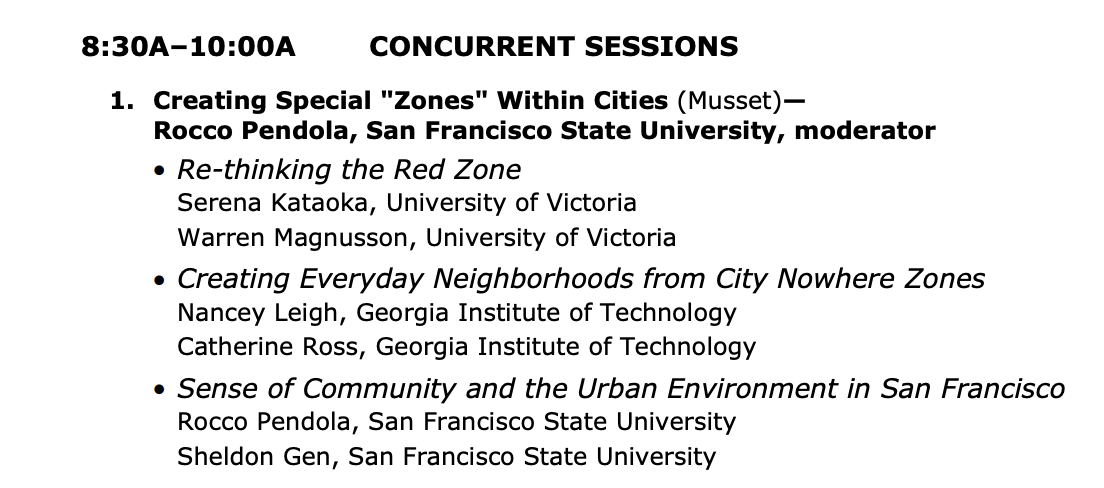
That’s from a 2006 conference in Montreal.
No coincidence. Being in Canada—as I was about to head to graduate school—connected even more dots that had been coming into focus for years.
A unifying theme in my urban planning studies was that European cities were better—by objective planning measures and from most quality of life perspectives—than American cities. I’d never been, but felt pretty confident that—with experience—this is what I’d come to discover.
I didn’t make it to Europe until 2022—at 46—but the second I set foot in Rome, I knew I hadn’t been misled by my professors and what I was reading. Shortly after that trip—and a couple others—my wife and I decided to move to Valencia, Spain.
We’ve been here for nearly two years.
I knew I belonged in Europe not only because the cities are better—though that’s a big part of it—but because of something I heard an American woman who lives in Norway say the other day on Joe Baur’s YouTube channel, as articulated by Joe in this video:
Gabriella hit on something there that really resonates with me as a fellow American immigrant to Europe.
I too was drawn by what I perceived as a kind of Pan-European spirit and the values that come with that. And it’s interesting running this channel because I interact with people who both see and celebrate that and those who think I’m a dumb American because I’ll talk about Europe as a single place…
But generally speaking, Europe is a place that despite current events, mostly celebrates its diversity, its social welfare systems that help protect people and honors their history by preserving the walkable cores of their cities instead of leveling it all for another parking lot.
And—focusing on current events—Canada, along with Spain, is exemplifying these values. Despite the typical fits and starts, Canada always has.
In many ways, Canada doesn’t feel like a different country when you visit from the United States. However, as we’re seeing now, Canada more closely resembles the social democracies that tend to prevail in a significant number of European nations. These shared commitments help create—with inherent fragility—the “Pan-European spirit” Joe describes.
Canadian pride and patriotism are real; they’re not a marketing pitch or indoctrination tactic like in the United States. When you tell Americans to “buy American” you’re just giving them another bumper sticker to deface an already soulless Walmart parking lot.
When Canadians come under attack, they respond, as we watch American isolationism and abject foolishness backfire in real time.
The response has been more than rhetorical.
Canadian travel to the United States fell 22% in 2025. After several provinces removed American liquor from store shelves, sales of U.S. spirits fell 66.3% within the first couple months of the boycott.
These and other data reflect what actual national unity looks like. Not every Canadian made the same choice for precisely the same reason. But enough people—and their governments—moved in the same direction to produce real economic consequences, not another marketing campaign or bumper sticker.
Could you imagine Americans doing anything even close in magnitude?
What has happened between the United States and Canada—and now between Canada and the European Union—didn’t create any of this for me. It reinvigorated something that has been a going concern for most of my life.
Whatever ultimately becomes of the still-undefined possibility of a closer formal relationship between Canada and the European Union, it didn’t suddenly make me Canadian. Legally, I already am—and the affinity has been there since I was 15. It made something I’ve felt for decades newly relevant and finally pushed me to turn my citizenship certificate into a passport.
Europe didn’t create the other major through line in my life either. It didn’t make me love cities or become skeptical of the way the United States organizes everyday life. It gave me more experience, better reference points, a wider and better-informed perspective, and daily contact with the things I’ve spent more than 30 years obsessing over, studying, and trying to understand.
Look again at the conference program from Montreal.
In 2006—when I was 30—I presented research titled Sense of Community and the Urban Environment in San Francisco. That title could almost serve as a description of the work I’m doing today.
Canada. Cities. Community. San Francisco. Nearly 20 years before we moved to Spain, these weren’t disconnected interests I would eventually turn into a story. They were already defining elements—even if I couldn’t yet see how clearly they were connected or where they would take me.
I didn’t stumble into what I’m doing or where I’m at today as part of some bandwagon hop.
I didn’t move to Europe and then work backward into a set of beliefs that made the decision look smart. Spain isn’t the origin—it’s just a logical next chapter that continues to produce long stories to make short or—when time permits—to keep long.
The same applies to my Canadian passport. It won’t create my connection to Canada any more than living in Valencia created my love for cities. Both give tangible form to things that were already there.
Most of what you believe at 15, 20, or 25—or even 45—fades. Some of it should. But when a few core convictions survive education, work, relationships, moves, contradictions, and decades of additional experience—and come into clearer focus along the way—they’re telling you something that’s just… cool and fulfilling.
At 51, recognizing this feels pretty special.
Not because it proves I was right all along. I’ve changed my mind about plenty and will continue doing so. It’s special because I can look back and identify themes that endured, evolved, and ultimately helped me build the life I’m living today.
And that makes me even more eager about what comes next.
I want to do as much as possible with the next 51 years. If I’m lucky enough to look back on them when I’m 102—when the end will, unfortunately, be a hell of a lot closer—I hope I see another collection of beliefs, experiences, and decisions that sustained one another and came into focus over time.
At 51, I’m celebrating that I’m still excited to see what the things I believe today will become over the next 51 years.
If you value writing that connects cities, culture, identity, and the decisions that quietly organize our lives, become a paid subscriber. Your support gives me the time to keep following these ideas wherever they lead—hopefully for the next 51 years.