

To be clear, if this type of stuff is all I have to complain about I consider myself a lucky boy.
But I’ve always been intrigued by how cities function—and dysfunction as they experience pivotal moments.
It started in the early 2000s when I regularly participated in, was obsessed with, and wrote about Critical Mass, the celebration of bicycles that now happens in hundreds of cities around the world:
The monthly gathering of friends and strangers, the subsequent reclamation of the streets, and the temporary urbanism created is the antithesis of what the American city has become… Never on time, real people - whole families, teachers, activists of all shades, messengers, nine-to-five office workers, old folks, teenagers, you name it - flood the streets, producing an unfamiliar picture of the city… With bikes and pedestrians occupying car-free streets for blocks - hooting, hollering, and cheering - it is as if streets designed for the singular purpose of facilitating auto traffic have been renovated into the finest of European public squares.
I wrote that in 2005 with lots of dashes, em and otherwise!
More than 20 years later, I’m still intrigued by the dynamic of cities changing, whether for a few hours or—structurally and demographically speaking—forever.
Like San Francisco’s Mission District, which experienced one of its first waves of gentrification during my Critical Mass days, Valencia—and cities from Mexico City to Melbourne—are at critical inflection points.
Because I love riding my bicycle, it's often the lens I choose to illustrate the bigger picture.
Whereas some places battle over bike lanes and pathetically turn them into little more than another culture war, others have good—and complicated—problems to solve.
In Valencia, it’s extra complicated.
If you enjoy this kind of reporting, I’d love your support.
My goal isn’t to become another travel writer.
It's to spend more time in places that are changing—walking their streets, riding their bike lanes, talking to the people who live there, digging into local policy, and explaining what those changes reveal about the bigger world.
Paid subscriptions make that possible.
They create the time and independence to do this kind of work—and to do it from more cities around Europe and, eventually, much farther afield.
If you believe thoughtful, on-the-ground reporting still matters, I'd be grateful to have you along for the ride.
Longish story short—the previous socialist administration basically transformed the city’s bike infrastructure. It’s not the best, but it’s among the best you’ll find anywhere in the world. If you come from most parts of the United States, you’ll find cycling here to be pleasant. You might even chuckle when people say things like cycling in Valencia is dangerous. Here cars treat cyclists with care and respect 95% of the time, whereas you’re anywhere between a target and a nuisance in most American cities.
So it’s all about perspective. It’s also all relative—when compared to other places and locally.
Between 2015 and 2023, Valencia underwent an aggressive transformation under Councilor Giuseppe Grezzi, increasing its cycling network from 64 to nearly 190 kilometers and reallocating 150,000 square meters of asphalt for pedestrians. Following a 2023 shift to a conservative administration, this rapid expansion has slowed to a "tense coexistence," marked by the reopening of major thoroughfares like Carrer de Colón to private traffic and the stalling of new Low Emission Zones.
Take Carrer de Colón. Under the previous administration, the street was closed to private cars to prioritize buses, bikes, and pedestrians, drastically cutting noise and vehicle volume. In late 2023, the incoming conservative government reopened lanes to private traffic—resulting in a 33% to 70% surge in car volume. While the bike lane remains, the street feels noticeably more hostile than it did a few years ago. As we speak, the street is undergoing a largely cosmetic transformation, missing the opportunity to reverse what was clearly a mistake.
That said, Colòn and most of Valencia’s core feels more than suitable for alternative modes of transportation—from my perspective. There are too many cars and too much traffic in some areas—something that’s impossible to not notice after you visit Paris or even Barcelona. If the right loses the next election, hopefully Valencia will continue with the great work they were doing before they took power.
But that’s only half the story.
The very bike lanes that transformed Valencia have become victims of their own success.
You can’t leave the house without seeing everything from scooters to e-bikes to the occasional shopping cart in the bike lane.
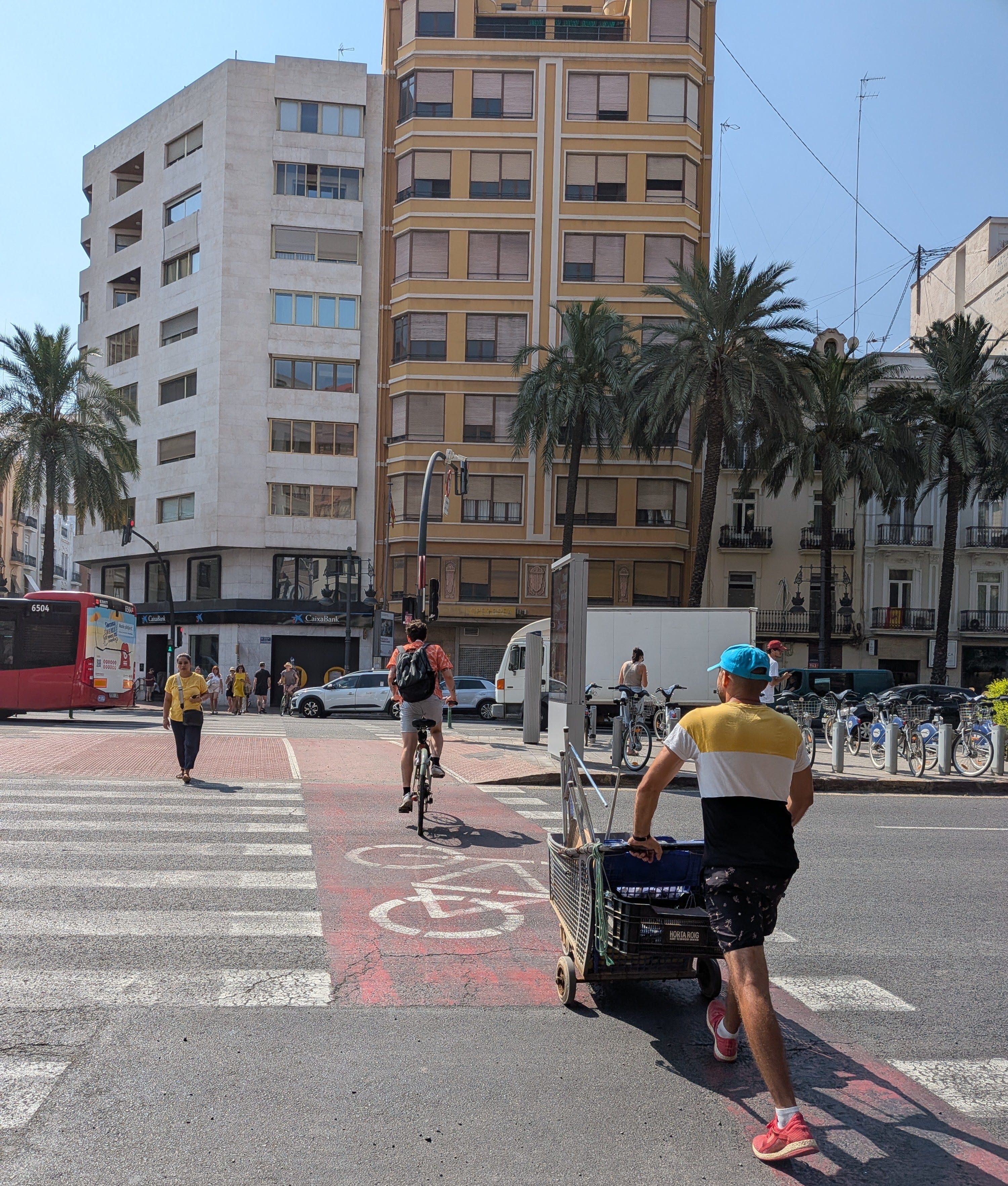
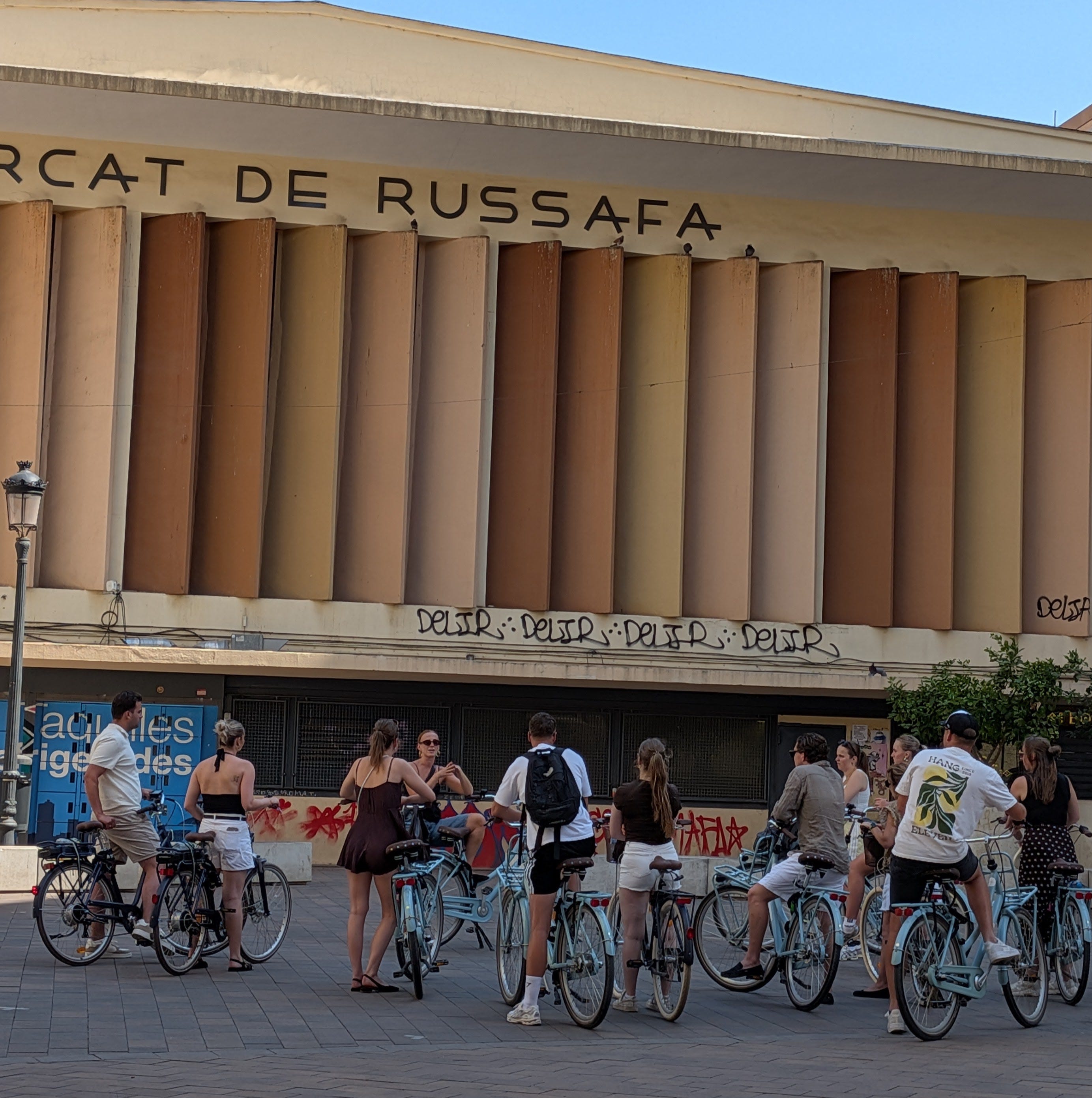
And just as bad, you also can’t go outside without seeing large groups of tourists—most often the Dutch, Americans, Brits, and Italians (in order based on my unscientific observation)—riding rental bikes on the sidewalks, across plazas, and through city streets.
I’m as big of a bicycle proponent as you’ll find, but Valencia needs to take a page out of Barcelona’s book and crack down on things like this.
So, again, none of this means Valencia’s cycling infrastructure has failed. It means the city has reached a different stage of urban development.
Twenty years ago many cities were asking whether they should build bike lanes at all. Valencia now needs to ask how to manage the success of having so many people actually using them.
That’s actually a great problem to have, but only if you have people in power who see it as a problem and have the political will to do something about it. Like in Barcelona, where Airbnb will cease to exist by 2028 and private bike sharing platforms will be out by 2027 because they don’t serve people who live in Barcelona.
Governments need to recognize that infrastructure isn't something that gets built once and walked away from—even if it didn’t happen under your watch. Cities and the way people use the streets evolve. Policy has to evolve with them.
Success creates new problems. Good governments solve those too, but—I guess—they must acknowledge their predecessor’s success in the first place.
Eventually, the practical has to meet the theoretical.
What is a bicycle and what is a bicycle lane?
If you lose sight of the answer to those questions, you lose control of conditions. And when you lose control of conditions in an area that seems insignificant relative to the bigger picture, you not-so-slowly start to lose control of the bigger picture.
Take it from me—I come from a place that not-so-slowly lost control.
All of that said—
Even under a conservative government that has slowed progress—and opposed measures like Low Emission Zones—the baseline expectation here remains remarkably different from what I’m used to.
People still broadly expect government to maintain public space—to keep things clean and functioning and generally improve the city.
The conversation hasn’t yet completely descended into whether bike lanes themselves represent some kind of ideological threat. At least not to the extent that it has at the United States’ Department of Transportation. And even where it has, there are enough people who operate with sanity in Valencia and in and around Spain and Europe to fight the good fight.
That’s a distinction worth protecting.
In America, bike lanes became another front in the culture war.
In Valencia, they’re crowded enough that the debate should be about how to manage them.
I’d rather have that argument every day of the week.
We have a similar issue with bike rentals/sharing here as well. I appreciate the service and am always happy to see people riding who otherwise might not be. That said, they are the worst offenders when it comes to inattentive riding, not following traffic rules, etc.
Love this. In Zurich we are struggling with all the electric scooters - just parked anywhere.
Rather like how London has black cabs and then “Boris bikes”, I think bikes and scooters need careful branding and management. I am in favour of a benign monopoly.
Now this does not require the city to be the operator but to own the rule book.
And this brand management is work-in-progress, never one-and-done.