

I used to be against bike lanes.
As a cyclist and urban cycling advocate in San Francisco circa 1999–2006, I was never in 100% unadulterated support of painted bike lanes.
I viewed them largely as government—city, state, federal—placation.
First, I didn’t think on-street bike lanes were always the answer to making the streets safer for cyclists. I still don’t. In fact, in some cases, they make the streets less safe. You know this if you ride in the street regularly.
In most places, cyclists have a right to the road. That includes the right to position themselves where it's safest—not where drivers think they should be. When you paint a bike lane on the side of the street, you also send a message that this is where cyclists belong. So when a cyclist leaves the bike lane and “takes” the traffic lane to avoid getting doored by a parked car, go around a double-parked vehicle, or for any other reason, car drivers often get more angry than usual.
There’s a bike lane there!
You fought for it so why aren’t you using it?
For the record, Spain recently passed a comprehensive law that includes requiring cyclists on urban roads to ride in the center of the lane rather than hugging the curb—a simple, practical measure to prevent dooring and aggressive passes.
Second, governments love to throw bones to not only placate activists but cleverly steer the progression of the conversation. It got to the point where activists started using the number of bike lanes as a measuring stick of success rather than focusing on true change—to the physical environment and to the prevailing car culture. Getting bike lane projects passed became the prevailing part of the fight. Bike coalitions and other advocacy groups around the world started proudly publishing statistics on how many bike lanes were installed over X number of years.
That’s basically where the United States has been stuck for years, but recently it appears to be getting unimaginably worse.
If these essays make you see familiar things differently, subscribe for free.
Every week I write from Spain about cities, psychology, politics, and the everyday systems that shape how we live. I’d love to take the newsletter on the road more often and report from other cities like I did for all of this past April from Paris, but I can only do that with your support.
So, if you do choose to upgrade, many thanks in advance.
It’s important to stop here and note that democratic politicians and policy makers have always—by and large—believed in and live life the American way. They drive from places like Maryland to DC for work and have homes in car-dependent suburbs.
Most Democratic politicians have never wanted to fundamentally rethink how Americans build cities. They want to make driving slightly less harmful—not less necessary. Bike lanes became an acceptable compromise because they didn't require challenging the underlying assumptions.
So don’t be surprised that the United States is in its present form on bike lanes and dozens of seemingly bigger issues. The country has been half-assing its way down a slippery slope for a long time.
But when I saw this on Substack, I couldn’t believe it was true.
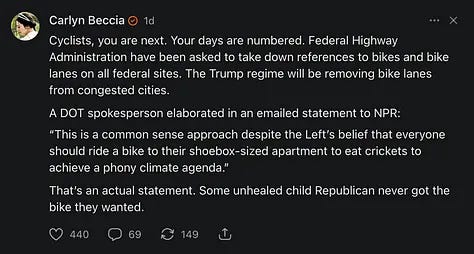
But it is.
And it’s pathetic.
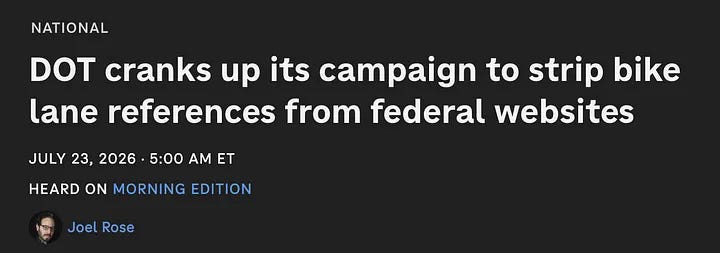
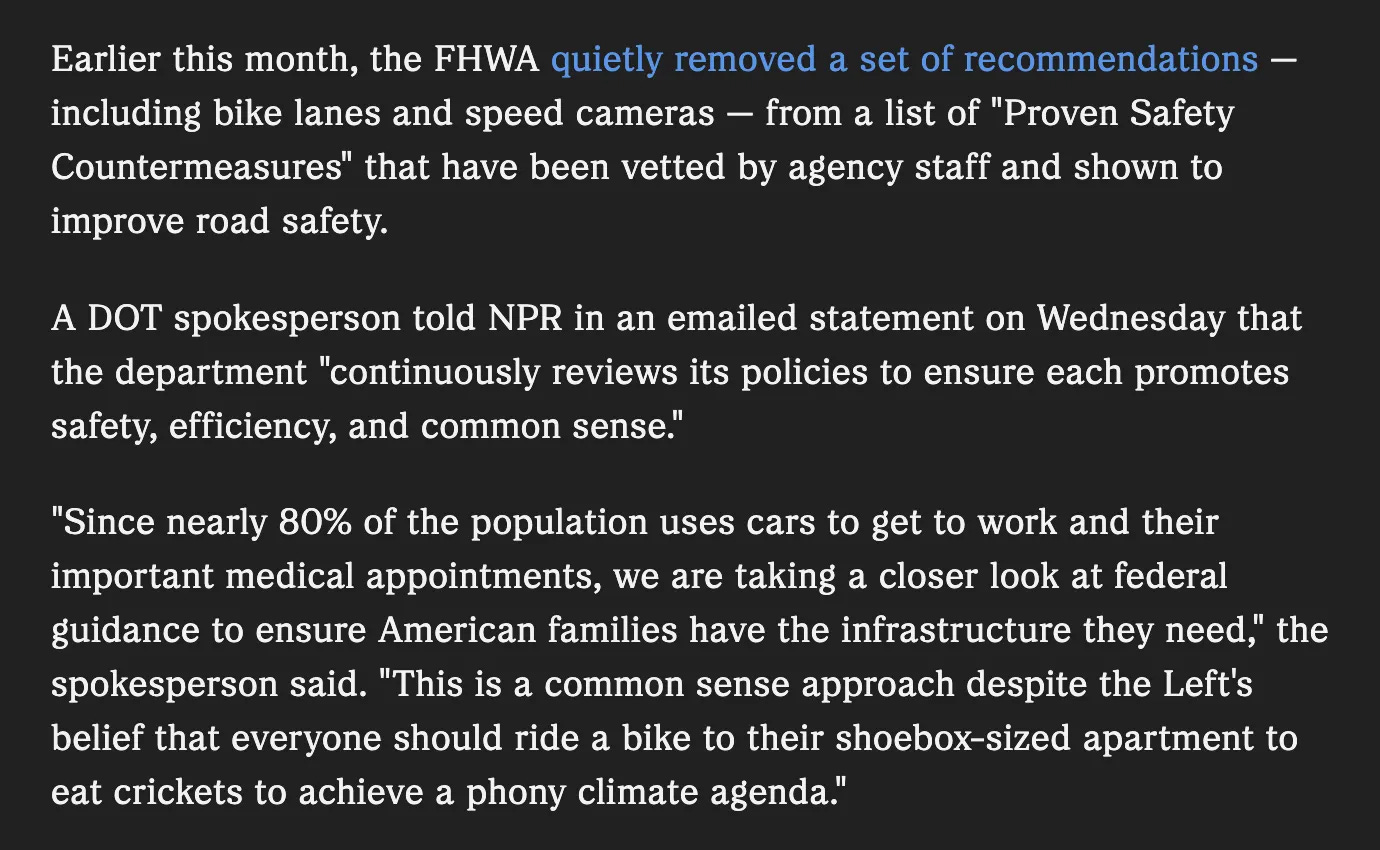
At first glance, an official DOT spokesperson ranting about 'eating crickets in shoebox apartments' feels like a satire piece. It doesn't feel real. But given the trajectory of American public life over the last few decades, it’s not surprising at all.
This bike lane situation is merely one illustration of something so tragic it literally makes me want to cry.
Across Europe, there remains a baseline of decency and sanity in the public sphere, even as the right and far right make gains in countries across the continent, including Spain. I can only hope Europe's different civic instincts keep it from sinking as low as the United States has.
For the time being, a key distinction still exists between the U.S. and much of Europe.
Society here still seems to believe that we owe each other functioning public space.
In the United States, more and more people seem to view public goods as zero-sum: if someone else benefits, they assume they're losing something.
Spain's democracy is only about as old as I am. I have to think that history—and Europe's broader skepticism of American-style politics—will cause enough people to push back if leaders here continue borrowing from Trump's playbook. I hope so, anyway. I'm just not sure Europe fully appreciates what it's signing up for if it moves to the right.
One of the hardest parts of what you sign up for when you elect populists isn’t only the politics.
It’s realizing you can no longer describe reality together.
My mother lives in a city along the Canadian border. During the recent wildfires she casually remarked, “Canada needs to get control of them.”
I knew exactly where that line came from.
Not because she’d studied wildfire management or suddenly become an expert on climate or forestry. She’d heard a version of it repeated often enough that it became reality.
That’s the tragedy.
The bike lane debate has little to do with bikes anymore. It's another version of the same tired story. Something designed to make a city slightly safer somehow becomes evidence that someone else is taking something from you.
The debate goes beyond transportation. It's about whether we still believe society owes strangers anything at all.
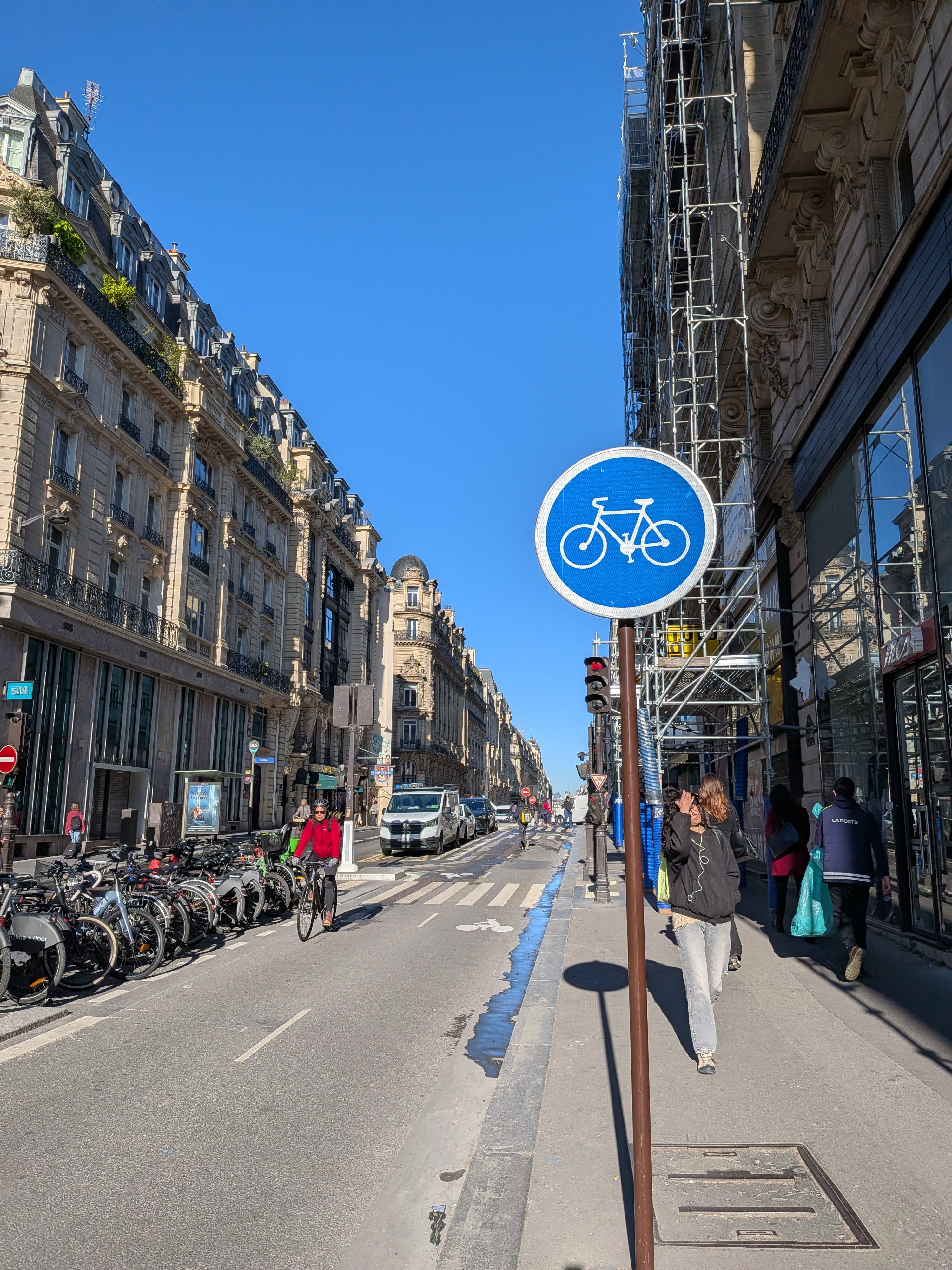
At the risk of sounding like a broken record, my city is the perfect example of this. Cobalt blue… “In this house, we believe” signs in every other yard, etc. Yet dare to talk about mass transit, bike lanes, etc., and people will look at you like you need an exorcism.
Politicians have cynically figured out how to weaponize this (doubly so in a state as balkanized as WI), and the end run is a few half measures here and there. For every road redesign, there 2-3 bike lanes or “sharrows” that disappear.
At the federal level, the dumbest people you know somehow managed to get in charge, and like 12 year olds delight in driving those wedges. Meanwhile, our kids and neighbors continue to be killed in bike v car incidents.
I know Sec Duffy was busy RV’ing around the country, but someone needs to remind him that bikes and paved infrastructure *are* forms of transportation and under his purview.