

People frequently ask me for practical advice and other insights into moving abroad.
I’m working on something called Same Life, Better System: The Never Retire/How It Works Guide to Midlife at Home and Abroad to put everything in one place.
Like literally everything. So, stay tuned for that.
But, for now, if I have to give any advice—it’s don’t believe what you read in the Facebook Groups about living abroad in Spain. They’re populated full of complainers and projectors who will make you fear everything about anything, especially picking up your life and taking it to a new country.
These—sorry, but this is what they are—entitled (mostly) Americans and Brits got in our heads. We expected everything to be a slow and bureaucratic nightmare—chock full of rude government employees and lazy tradespeople—in Spain. Reality has been the exact opposite.
And I’m convinced it’s because:
You get what you give. Act like an entitled “expat” and you’ll (rightfully) be treated like one.
These people have never been content. They took bad attitudes and transplanted them to Spain.
👇 If you’re new here, subscribe to How It Works—I write about the real mechanics of living abroad, staying engaged in midlife, and systems that actually function.
People assume that if they’re not a stereotypical American—not MAGA, not nationalistic, not screaming about freedom and Costco—then they’ll automatically thrive abroad.
But that’s not how this works.
Just because you didn’t vote for Trump, you post about him on social media while watching Jimmy Kimmel (like he does), and you know what a prime minister is… doesn’t mean you won’t arrive in Spain and expect the country to bend to your will.
That’s the part people who talk about moving don’t want to hear.
And I don’t say this from a place of superiority.
I say it because I’ve watched so many well-intentioned Americans fall into this exact trap—smart, progressive, thoughtful people who truly believe they’re immune to American conditioning… right up until the moment something is different and they treat the difference like a problem.
I see it every single day—in the Facebook Groups, elsewhere online, in conversations with Americans we’ve met, and generally in the streets. I have met people from the United States, including some who have lived here for about a decade. They know close to zero Spanish, yet complain about things not going smoothly for them in retail, hospitality, or bureaucratic settings.
It’s nothing short of pathetic.
I didn’t land in Spain expecting everything to be easy.
I didn’t arrive thinking my mindset or passport made me special.
I didn’t come here seeking comfort.
I wanted discomfort at midlife. And I understood, long before I left Los Angeles, that discomfort is part of the deal.
That’s the difference—not virtue, not intelligence, not politics, not worldliness.
Knowing yourself. Like truly having an awareness of who you are and being able to project… not project your insecurities onto others, but to see yourself and how you will actually function in a future situation. This requires knowing yourself as well as the place you’re going and exactly why you want to go there.
I guess that’s another piece of advice.
You need to know about the systems that shaped you and the habits you carry. You need a crystal-clear comprehension of the reality that moving abroad isn’t a personality makeover — it’s a cultural recalibration.
Most Americans—even the ones who will blow this off like teenagers receiving a lecture—don’t realize how deeply the American model wired their expectations.
They think untested tolerance of other cultures and criticism of America guarantees them success in another country. They think voting a certain way equals connection with leftist Europeans or the ones on the right who would be—according to a myth perpetuated by liberal Americans—left of center in the US political system.
None of that (the things that are true or the things people make themselves believe) prepares you for the moment you’re actually living inside a different system—a calmer system, a saner system, a system that doesn’t respond to you the way you’re used to.
I’m not saying this because I did something heroic. I’m saying it because the people who do well abroad aren’t the ones who know the most—they’re the ones who resist the least.
They don’t arrive demanding comfort. They don’t arrive expecting replication. They don’t arrive treating cultural difference as malfunction.
They arrive curious. They arrive flexible. They arrive ready to be uncomfortable without reading it as failure.
That’s the whole game.
And most people—genuinely, unknowingly—show up without that readiness.
I have come to believe that comfort is rarely that. Most of the time, it’s conditioning. You get used to something, so it’s easier to roll with it than it is to budge. Than to challenge yourself out of your predictable status quo. But when you don’t, you’re leading yourself down the primrose path—Mrs. Bueller!—to stagnation.
So Americans end up talking about “comfort” like it’s this sacred birthright—comfort food, comfort zones, comfort levels, comfortable living. But American comfort is almost never actual comfort. It’s predictability disguised as well-being. It’s control disguised as ease. It’s a system engineered to keep you overstimulated, overextended, and under the illusion that familiarity equals safety.
Why in the world would people like my parents—ever since I was a kid—view other countries that don’t have guns and a fraction of the murder rate of the United States as somehow unsafe?
If your nervous system has been calibrated to American “comfort,” Spain can feel jarring at first. Because it sits at a lower frequency.
American comfort is a high-frequency comfort—comfort that lives inside noise, rush, urgency, (alleged) convenience-on-demand, Yelp reviews, customer-is-always-right/how-can-I-help-you-today performances, and the emotional friction of constantly needing something from everyone around you.
Spain operates at a low-frequency comfort—the kind that lives in shared public space, collective norms, fewer choices, virtually zero public displays of hostility or palpable tension, and a general expectation that life doesn’t exist to cater to your preferences.
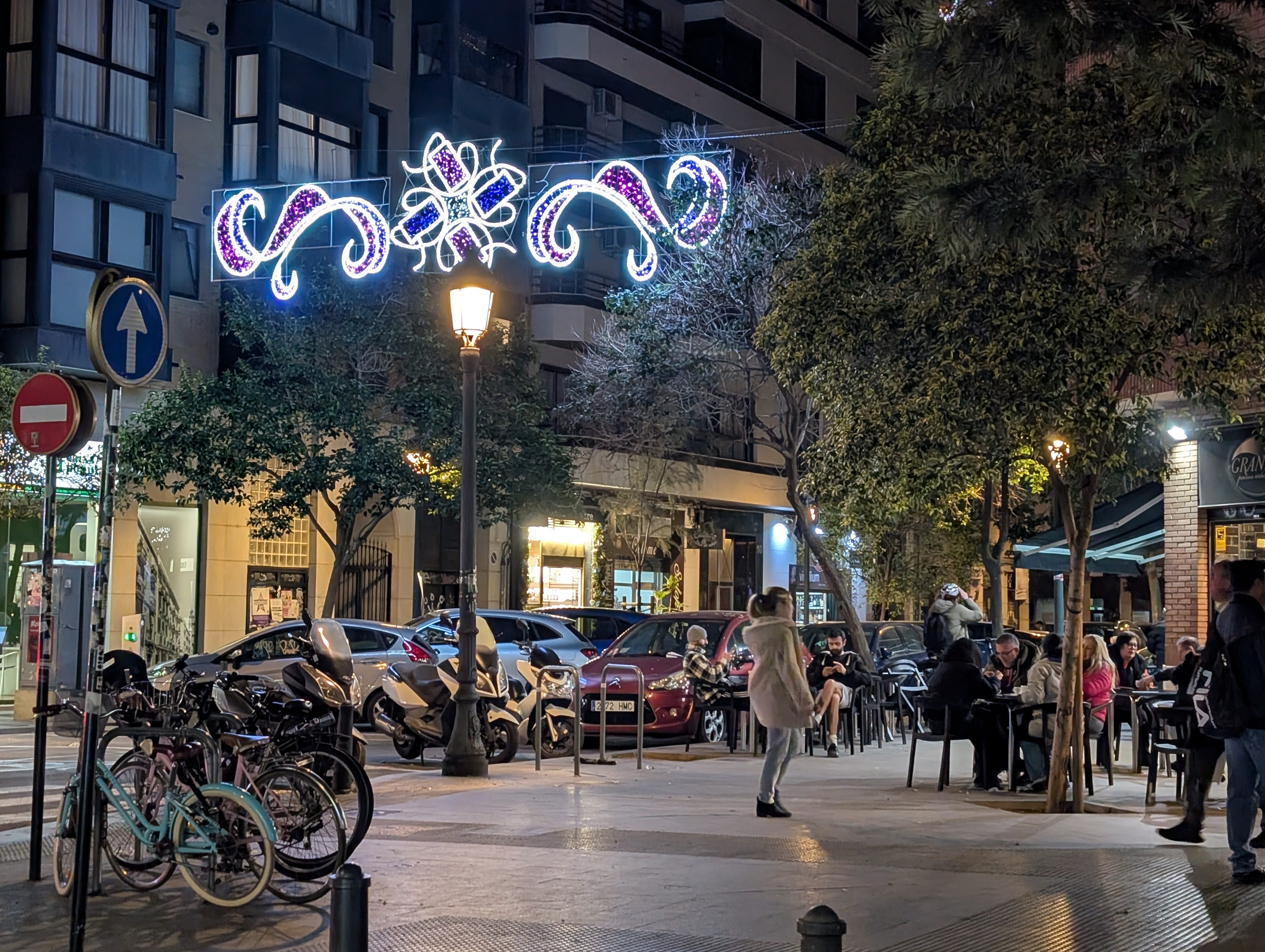
And—if you get over yourself long enough to stop and look around once in a while—you not-so-slowly realize that the true land of convenience, efficiency, and opportunity is urban Spain. Not the hollowed-out, overpriced cities and endless suburban hinterland of the United States.
Most Americans—and let’s not forget the Brits—don’t realize how deeply their comfort threshold has been inflated by American culture until they’re dropped into a system that doesn’t care about their preferences, doesn’t reward their urgency, and doesn’t move at their pace. If you want to walk fast in Spain, you walk around people standing still in the middle. Not through them. This isn’t New York or any other place where impatience is a virtue.
And that’s where the unraveling begins.
Because if you’ve spent 40 or 50 years equating control with comfort, then any system that runs on trust, patience, or collective rhythm will feel like a personal affront to your identity. You treat the new system, the way Americans treat each other in the streets—never letting anyone pass and always trying to get there before the people in front of and behind you.
That’s the psychology many people dreaming of or prepping to move abroad fail to analyze:
They think moving abroad is about geography when it’s actually about identity.
Most people don’t fail abroad because the new country is hard. They fail because the old version of themselves is.
They show up as the person they were in the U.S. (or the U.K.), and they expect the new system to accommodate that person. Not out of arrogance necessarily, but out of unquestioned habit. There’s no doubt that parts of you have to change—or, at least, adapt big time—when you move abroad.
And this is where people get rattled.
Because “comfort”—the thing so many people want to protect (you think US military members die to protect “freedom!?”)—is almost always the first casualty. Not because Spain is uncomfortable, but because the version of you that could only function inside American comfort doesn’t translate here.
Moving abroad isn’t supposed to feel comfortable at first. If it doesn’t, you’re not doing it right.
At midlife, discomfort is not a crisis. It’s a strategy.
It’s the thing that keeps you from sliding into autopilot, from aging in place without noticing, from slowly becoming the kind of person who talks about wanting change but never does anything that would require it.
Spain functioned quite well without me. It doesn’t need me. To make the most of the privilege of being here, I owe Spain presence, flexibility, curiosity, and humility. All the things America quietly drains out of you.
Those are the exact traits you need if you want to stay vibrant, engaged, and awake to your own life in your 40s, 50s, and beyond.
That’s why I get skeptical when people treat “expat” groups or English-speaking meetups as the default solution for loneliness, confusion, or early-stage discomfort.
Because here’s the truth lots of people who move don’t want to admit: If your first instinct, in a new country, is to recreate your old life… you probably shouldn’t have moved.
You weren’t looking for change—you were looking for an extended vacation.
You weren’t looking for a new system or a different culture—you were looking for your old one, but cheaper and prettier.
And that’s why so many people stay stuck in the “expat” loop: surrounded by other people who also aren’t integrating, who also aren’t learning the language, who also want Spain to be America-with-tiles, cheap beer and groceries, water you can swim in… and who reassure each other that the problem is the country, the paperwork, the pace, the people—anything but themselves.
But if you’re moving abroad with the intention of actually growing—of rewriting the second half of your life with clarity instead of conditioning—then discomfort is not an obstacle.
It’s the way forward.
Moving abroad doesn’t makeover your personality. It reveals it. And gives you a chance—finally—to decide what you’re going to do with that information.
That’s the real How It Works.
Not the logistics.
Not the visas.
Not the tapas.
But whether you’re willing to sit inside the discomfort long enough to become someone who doesn’t need comfort as an identity—just a quiet, stable foundation to keep growing from.

If you’re tired of the sugarcoated “expat influencer” stories and want writing that tells the truth about living abroad—the hard parts, the growth, the systems—subscribe.
This is where the real conversation happens.
A couple of interesting dynamics here:
First, I can empathise with the notion of accepting some discomfort.
Organising your life in a new place is something that you have to make the effort to do. You have to put in the work to understand how things work locally. We have just moved in Switzerland, which administratively would win Olympic gold for quality of execution in public administration. Now a few of our cities would win gold for overspending too, but that is another thing.
Friday, I called up "city hall" to check that the on-line process to formally de-register where we were and re-regiser here in the mountains had worked. A couple of questions and we were done. The lady on the phone even offered to do our new "local citizens pass" the same day. Just fab. Then, we went to buy ski-lift tickets. We should have been able to get a local discount and access to the entire area of Lenzerheide-Arosa; a mate of ours works at the ski-lifts and told us what we are entitled to. The ladies on duty did not see it the same way. It's a specialist thing. We just retreated and are ready to come back another day.
The other dynamic is speed.
When I have been in London and New York, even Zurich, we are always on a tight schedule. Typically, that does not allow us the luxury of taking a bit more time.
These posts have inspired and reminded me that doing just that is something worth striving for nothing up here in the mountains and in South Africa when we get there.
"Expat Loop". You should trademark that (a clearly American idea).! :-)