

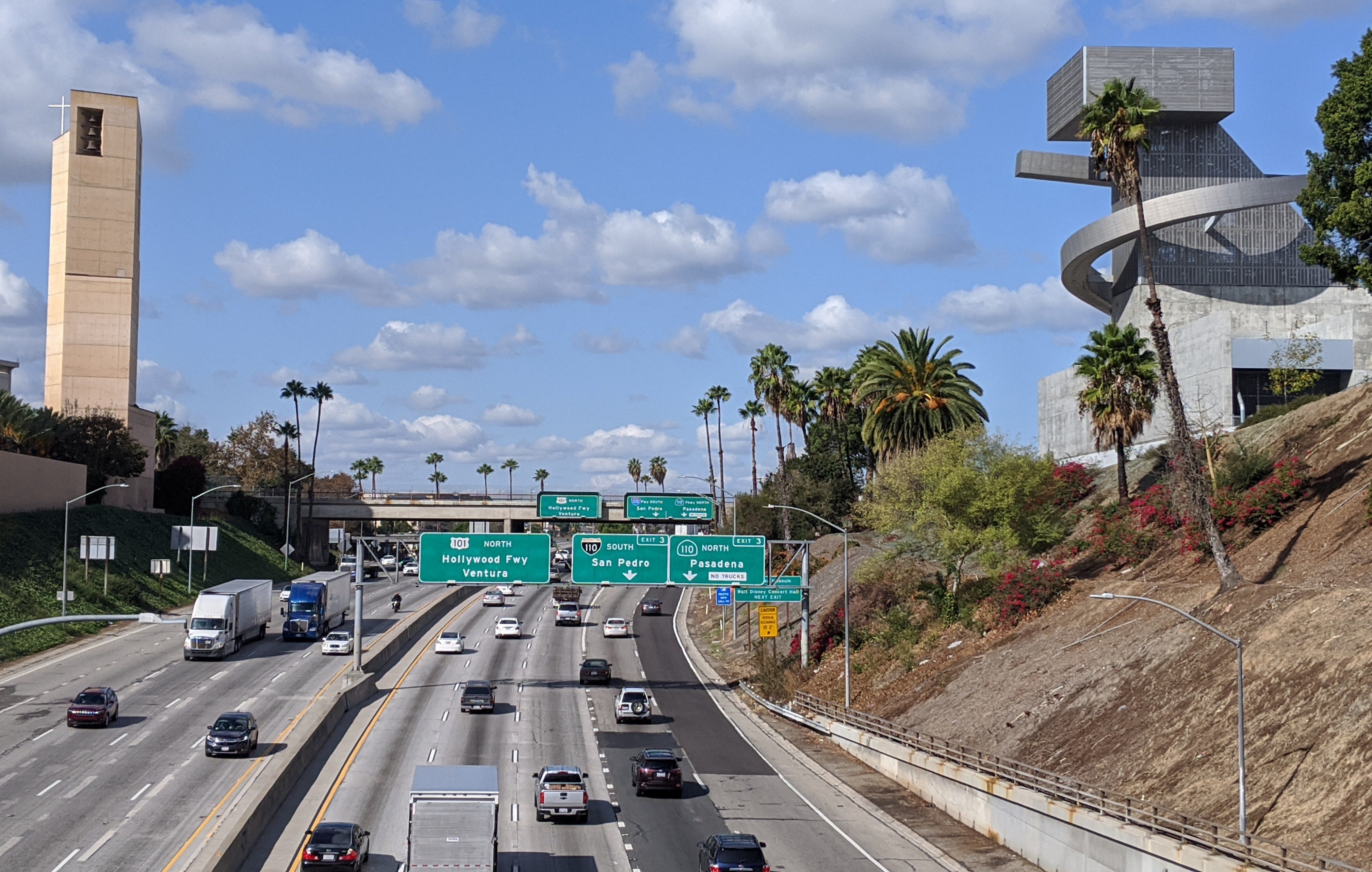
That’s the heart of Los Angeles right there.
And a freeway runs through it.
The drivers in that traffic—which is usually worse—will choose an exit, maybe from the 101 or one of the other freeways connected to the 101.
Then, they’ll proceed to drive in freeway mode through the city to their destination, which is often one of the largely residential enclaves that surround the urban cores scattered throughout the LA area.
Everything is designed to rapidly move you through space and time when traffic isn’t an obstacle.
You have a destination and everything between you and that destination is in the way.
I bring up Jane Jacobs a lot. That’s because she’s important.
Her ideas could actually make America great again. But not many people have a real interest in doing that.
From an urban planning perspective, Manhattan is about as good as it gets in the United States of America.
Jacobs deserves far more credit for this than she receives.
In the 1960s, highway builder Robert Moses planned to slash a ten-lane elevated freeway through the heart of SoHo and Little Italy. He called it the Lower Manhattan Expressway (LOMEX). To Moses, these weren't neighborhoods; they were just blight standing in the way of a car pipeline.
Jacobs led the grassroots insurrection that killed the project entirely in 1969, effectively saving Manhattan from making the same mistakes that plagued cities through the US, including San Francisco.
The defeat of LOMEX saved the historic, cast-iron loft buildings of SoHo and transformed New York’s approach to urban development away from massive highway projects and toward preservation.
Manhattan avoided what ended up being Los Angeles’s fate and present legacy.
When I was a kid living in Upstate New York, I didn’t think twice about taking the Robert Moses Parkway between my hometown of Niagara Falls and neighboring Lewiston. Years later, when I studied urban planning in San Francisco, I discovered how destructive Moses and the things he built were.
Most people don’t think twice. There’s no reason to think twice. When you grow up American, few people encourage you to think twice—especially if you’re from a working/middle class background.
So we ignore features of the built environment that profoundly impact—and, all too often, degrade—our day-to-day experiences and overall quality of life.
Given how freeways dominate and dissect the landscape throughout Los Angeles—and many other cities—it’s no surprise what happens when cities attempt to calm traffic away from them.