

If you’re looking for something to read beyond this newsletter, don’t just Google, but Google Scholar “weak ties.”
Your search will result in a mountain of academic research.
Despite decades of testing the weak ties theory, I think the original logic still applies, particularly when we’re talking about the two things we talk about most in this newsletter—living city life in general and living it after moving abroad.
Introduced by sociologist Mark Granovetter on Stanford Report in 1973, the weak ties theory states that casual acquaintances and loose connections are more valuable than close bonds for sharing novel information and bridging separate social groups. In city life, these low-stakes interactions with neighbors and shopkeepers help prevent social isolation and integrate individuals into the broader urban fabric.
If essays like this interest you, subscribe below.
Every week I write about cities, finance, and everyday life through the lens of living in Europe—not as travel writing, but as a way of understanding how different societies solve the same problems.
I’ve been obsessed with this broad area of research since I enrolled in San Francisco State University’s urban studies program in 2002 and went on to pursue—and not complete—my PhD at UC-Irvine in 2006.
I became so obsessed that I wrote a paper on a concept that’s basically the complete opposite of weak ties. The paper—in one of the top five achievements of my life—passed peer review and made into an academic journal in 2008. (I know I mention that often, but I remain proud of it all these years later):
Creating “community” has long been a goal of urban planners. Although such rhetoric abounds in planning circles, what it all means is unclear. In this article, the authors review the community psychology and urban planning literature, defining sense of community within the context of how the built environment might facilitate or impede it. They then present their research, which tests the effects of “main street” on sense of community in four San Francisco neighborhoods. Results indicate that respondents in neighborhoods exhibiting characteristics of a main street town (Bernal Heights and West Portal) have significantly higher sense of community than do respondents from a high-density neighborhood (Nob Hill) and from a more suburban-style city neighborhood (Sunset).
If you’d like a copy of the full article, let me know and I’ll send one to you.
Anyway—
That’s the thing. We’ve been throwing around the phrase sense of community to describe the social relations we have in what we consider great neighborhoods and other settings, such as clubs, for years. While these social situations and groups might indeed be great and fulfilling, they don’t always cross the line into sense of community.
In between weak ties and sense of community—a mediator maybe—is social interaction.
This is where the rubber meets the road.
Consider the psychological construct of sense of community (SOC):
SOC has been defined as “a feeling that members have of belonging, a feeling that members matter to one another and to the group, and a shared faith that members' needs will be met by their commitment to be together”. As the definition indicates, SOC is an emotion-laden construct that stresses feelings of togetherness and a communal spirit....
The situation I’m in where—if everyone I “know” in the neighborhood happens to be in their “place” at the right time—is a far cry from sense of community.
I might walk out the door and have small talk with the guy who owns the store next door, say good morning to the guy who runs the bar on the other side next door, walk past the guy who sells eggs at the Russafa Market entrance and say hello, then have limited conversations in Spanish with the three or four vendors I regularly buy stuff from—all people who would recognize and acknowledge me if we bumped into one another on the street.
Those things rarely happen all at once—in succession—but they happen individually and in tandem every single day in the neighborhood.
Then, I can go to our coffee shop of choice—where they not only know my order, but once prepared it ahead of a line of tourists ordering complicated drinks, and where they know that I have a cortado when I’m about to go on a bike ride, but an Americano when I’m not riding.
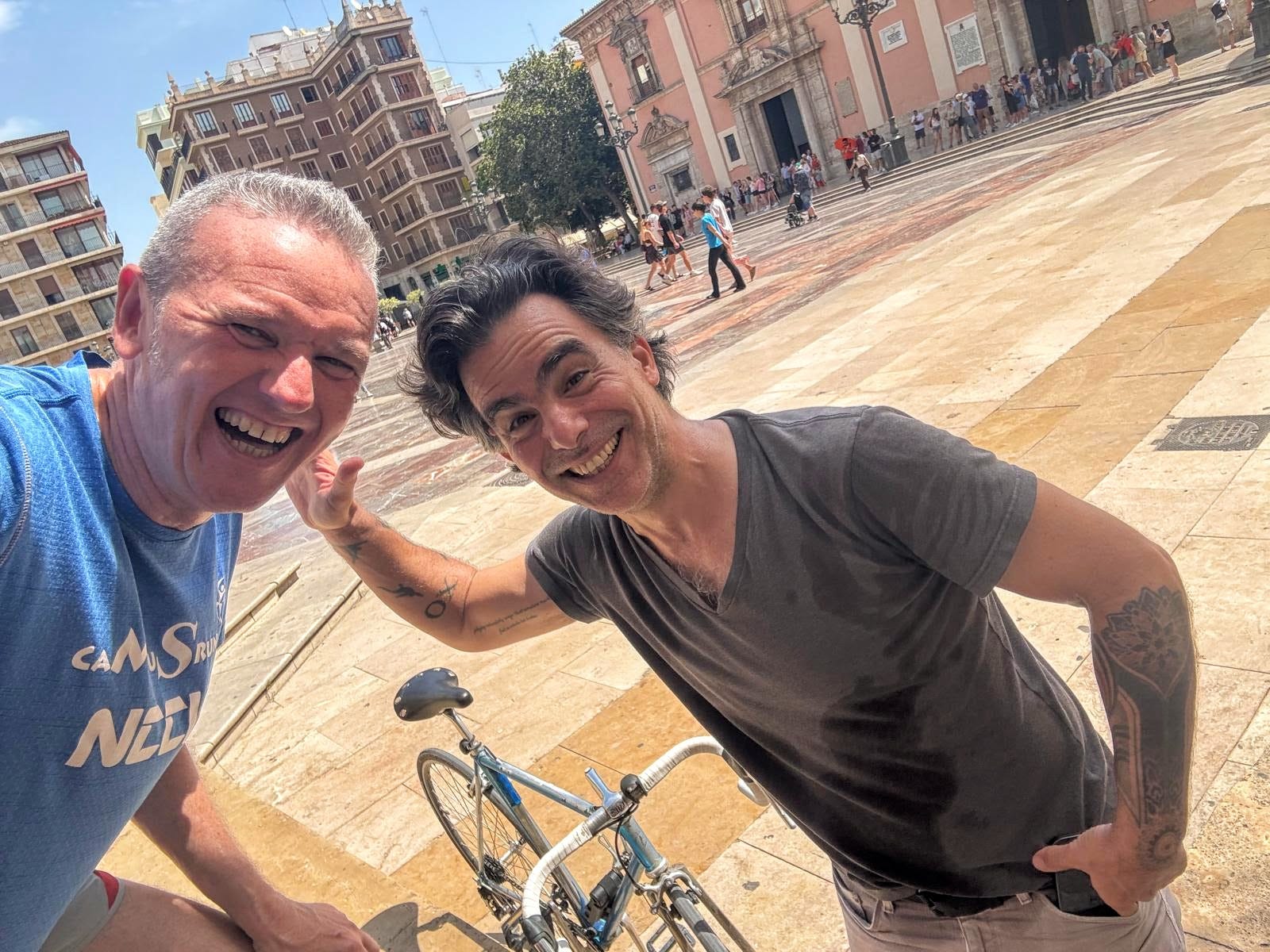
On a recent weekend bike ride, I wound up in a plaza in the center of the city. A Spaniard friend was out for a run. We randomly bumped into one another, talked, and took a picture together to send to our wives. We’ll have dinner or something next month. We like each other a lot.
We’re going to our Puerto Rican friends’ house for dinner this weekend. Other Spanish/German friends let us know they’re heading out on summer vacation and, if we can’t meet up Saturday, we’ll see one another when they get back.
We might be compelled to say—wow, you’re experiencing sense of community in your neighborhood. But if you simply look at the introductory definition, you’ll see that this isn’t the case. Dive deeper into the research on SOC and I have nothing close to sense of community.
And that’s not necessarily a bad thing. In fact, I think it’s a good thing.
As a society, we have taken sense of community—unknowingly—from academia and turned it into a popular term that even professionals, such as urban planners, loosely throw around, as I observed in 2008.
Nothing has changed—at all.
I have weak ties in my neighborhood, which is basically a nonstop accumulation of informal social interaction. Some of it could one day cross from formal informality among forced acquaintances to actual friendships you’ll maintain and develop with people over time.
It’s this mix that matters more in your day-to-day life than trying to build what amounts to a complicated bond. In fact, it's close to literally impossible for this mix I’m in—really any substantial part of it—to convert into a sense of community. There simply isn’t enough shared identity or history. Plus, there’s a language barrier. But even among people who are friendly and speak the same language, it’s unlikely that there’s actual SOC.
Which leads to the tragedy of suburbia. When you live in the suburbs, you have people on either side of you and these are the people who are part of your immediate day-to-day life beyond your family and actual friends. Then the suburbanite gets in their car, maybe stops at Starbucks—where you can literally just take your order off of the table now without interacting with a soul—and goes about their socially isolated day until they mingle with their co-workers.
Their place of work takes on increased importance—just like their immediate neighbors. These people better be cool if I want to have anything resembling a fulfilling social life outside of my immediate circle. Some hit the jackpot on all or some of this. Others don’t.
Only compact city neighborhoods can naturally and regularly produce what I have—weak ties constructed through constant informal social interaction. And that’s the beauty of functioning urban neighborhoods and the accumulation of encounters they uniquely facilitate. With them you feel like you’re part of something—part of the urban theater. And from that you can slowly build something bigger and more rooted, which is part of why I like to travel frequently, but have no interest in being a digital nomad.
Without this quintessentially urban dynamic, you run the risk of feeling isolated. I don’t believe in joining groups as a way to “integrate” into a new situation—at home or abroad. Because when you do you just place yourself inside another complicated area of academia—group psychology.
No matter why they joined, in groups people emerge to take the same roles that exist in every other group. And, typically, it becomes more about peacocking, dick measuring, and establishing social status than it does having fulfilling things to do and exploring potential friendships with one another.
I don’t think the goal of city life—or of moving abroad—is to create an instant sense of community.
It’s to stop feeling like a visitor—and like less of an imposter.
Weak ties, repeated encounters, and countless ordinary interactions do that better than almost anything else.
They’re easy to overlook because they’re so ordinary.
They’re also one of the most extraordinary things that well-functioning neighborhoods can provide.
If this essay changed the way you think about neighborhoods—even a little—that’s exactly why I write this newsletter.
Every week I explore the hidden systems that shape everyday life, from city streets to banking to the psychology of belonging.
I’d love to have you here.
I’ve been in Prague, Cologne, Bonn, and Amsterdam in the last ten days. What has been a gift for this American suburb dweller are the “third spaces.” The open air markets with fresh vegetables, local food, and local flowers. The city governments with plazas at their feet. There are people walking together, greeting vendors they know, and laughing over shared jokes (probably a few about this tourist).
I’m hungry for this.
Yesterday my wife and I were out for a walk on the paths around our village, Lenzerheide, here in Eastern Switzerland. Loads of walkers and mountain bikers.
At one point we passed an older gent, using walking sticks. As is the norm here we said “Gruezi”, the typical greeting. He replied and then asked us where we were off to. We replied, not thinking too much of it. Behind us, a mountain-biker came up and the man asked him to stop so he could ask something about his bike. Then it dawned on us; the old man just wanted some social interaction. We’d missed a trick.
Having friends, people you stay in contact with and meet up with is certainly a good thing. Few of us will have friends around us every day. Those social interactions help fill the gap.