

As I was writing, I kept coming back to the same worry: This is a potentially unsatisfying post.
However, the more I reread it, the more I concluded that I need to be comfortable with that. Because I refuse to sell certainty to make an inherently uncertain situation neat and tidy.
My hope for this newsletter is that it helps you think through the messiness of where you live—or might want to live—and why. I’m not here to inspire, dazzle you with romanticization, or bombard you with problems I position myself to help you solve.
I don’t sell masterclasses or offer one-on-one consultations. I think most of that is opportunistic noise for people looking in the wrong place for clarity.
There’s a ridiculous irony in using a car analogy to make this point, but here we are.
A lot of people do a better job deciding what type of car to buy than deciding where to live.
When people buy a car, they tend to ask practical questions.
How am I actually going to use this thing?
Do I commute? Need cargo space? Kids? City driving and parking? Long highway trips? Bad weather? Fuel economy? Maintenance?
When somebody considers a crazy sports car purchase, one of three things happens:
They buy the car and—often—look like an idiot.
They wait, make a rational purchase, then—if their financial situation supports it—buy the sports car. (And maybe still look like an idiot).
They don’t buy the car—coming to their senses to realize that, based on the utilitarian nature of a motor vehicle—there’s no need for a turbo-charged Porsche.
But when people think about where to live—especially when moving abroad—that kind of clarity often disappears.
Suddenly the decision-making process becomes emotional, performative as they attempt to mimic what they’ve seen online, and often deeply unserious.
It becomes a discussion around whether the locals will accept you, how quickly you can open a bank account, and how much you’ll pay in taxes. So loads of people go into their scouting trips and relocation masterclasses focused precisely on the wrong things.
None—or not much—of what they’re doing gets to the real question.
What kind of ordinary life are you actually trying to build?
I probably see this differently than most people.
Not because I’m uniquely brilliant—though that helps!
But because I’ve spent the last 26 years thinking about cities.
I fell in love with urban life first.
Then I studied urban planning.
Then I spent decades paying attention—not just to architecture or aesthetics, but to how cities actually function. And how I feel and function inside of them.
Neighborhoods are less about density as a concept and more about exactly what’s within reach. They’re less about an abundance of bike lanes or public transit and more about where I need to go and how I’d like to get there. And taxes—as hard as they can be to pay—are less an expense and more the cost of admission for an actually high quality of life. Not a learned myth or a marketing slogan, but a reality you can touch.
The mechanics of day-to-day life that dictate whether daily life feels fluid or exhausting.
That background is a huge part of what brought me to Spain.
And it’s a big reason I can usually tell the difference between a place I enjoy visiting and a place I could actually live.
Thanks to our latest paid subscribers—from Paris to Ann Arbor and Barcelona to State College, PA. And to long-time newsletter subscribers who have added additional support beyond what they paid to subscribe originally.
Support like that helps keep this project going.
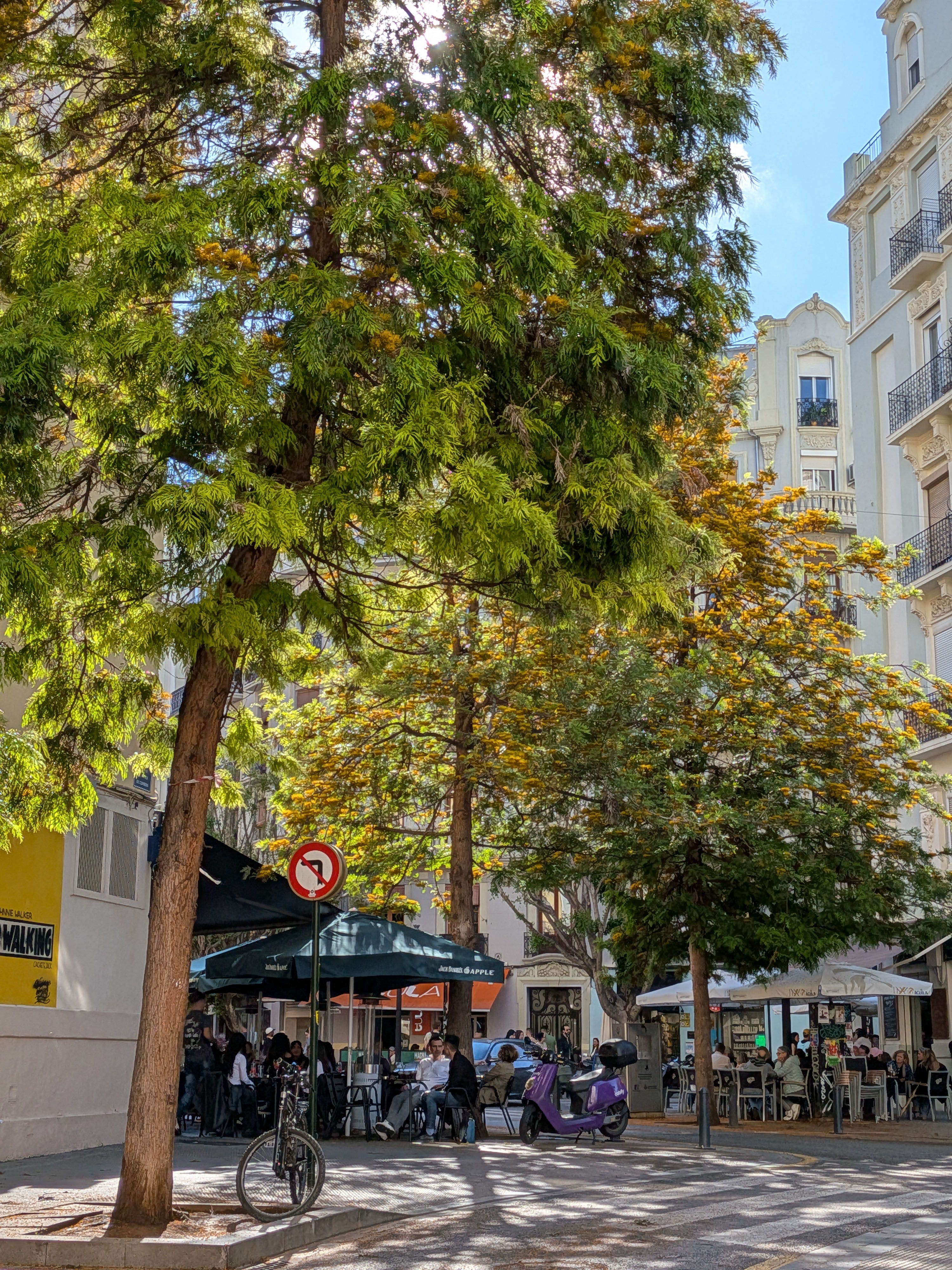
Valencia is probably the best concrete example of this.
We visited one time—briefly.
It rained a lot. It was windy.
We weren’t blown away—no pun.
There was zero pomp and circumstance. No cinematic “we have to live here” aperture. No can you believe people get to live like this everyday idealized moment.
We left, thought about Valencia, and reassessed it.
We compared what we knew about ourselves to what we understood about the city and what had been developing there.
Then decided to move.
And after making that decision?
We didn’t come back before actually relocating. On a subsequent trip to Europe before moving, Valencia wasn’t even on the itinerary—even though we knew we would be moving there. There just wasn’t any need to see the city again—as if she was a long-distance lover.
Which sounds insane if your framework is scouting trips, YouTube walkthroughs, and “expat” forum obsessing.
But perfectly logical if your framework is different.
This is where people start to get frustrated.
Fair enough.
Because what most people want here is a clean framework. A process or checklist—something they can optimize.
That’s understandable.
If your life feels unsettled—politically, emotionally, professionally, existentially—it’s comforting to believe the answer is procedural.
Compare visas, build a spreadsheet, and take a scouting trip. Watch 37 YouTube videos from smiling people who moved to Portugal six months ago. Buy somebody’s relocation course.
It’s all about turning uncertainty into process.
Because process feels like control.
But often, it’s just avoidance.