

The other day I spilled some ink (line credit: Kevin Alexander) on maybe my favorite paragraph of the year:
I've lived in Valencia for nearly two years and I rub elbows with “grandmas” (nonnas or abuelas) every single day in my neighborhood. They're not paid extras giving tourists what they want. And there's nothing wrong with finding some type of joy in that. Not a day goes by when I don't think of my Italian-American grandma as I walk the streets of Spain or, even more, when I visit Italy.
It comes from an article you should read after you read this one.

In the shell of a nuanced nut, I argue that tourists are an all-too-easy target in the increasingly populist and simplified debate around housing and gentrification.
Sure, quite a few tourists suck.
Before we ban Airbnbs, we probably need to restrict suitcase-rolling Americans, loud beer-swigging Brits, and large groups of bike-riding giants from the Netherlands.
But that’s another story for another day.
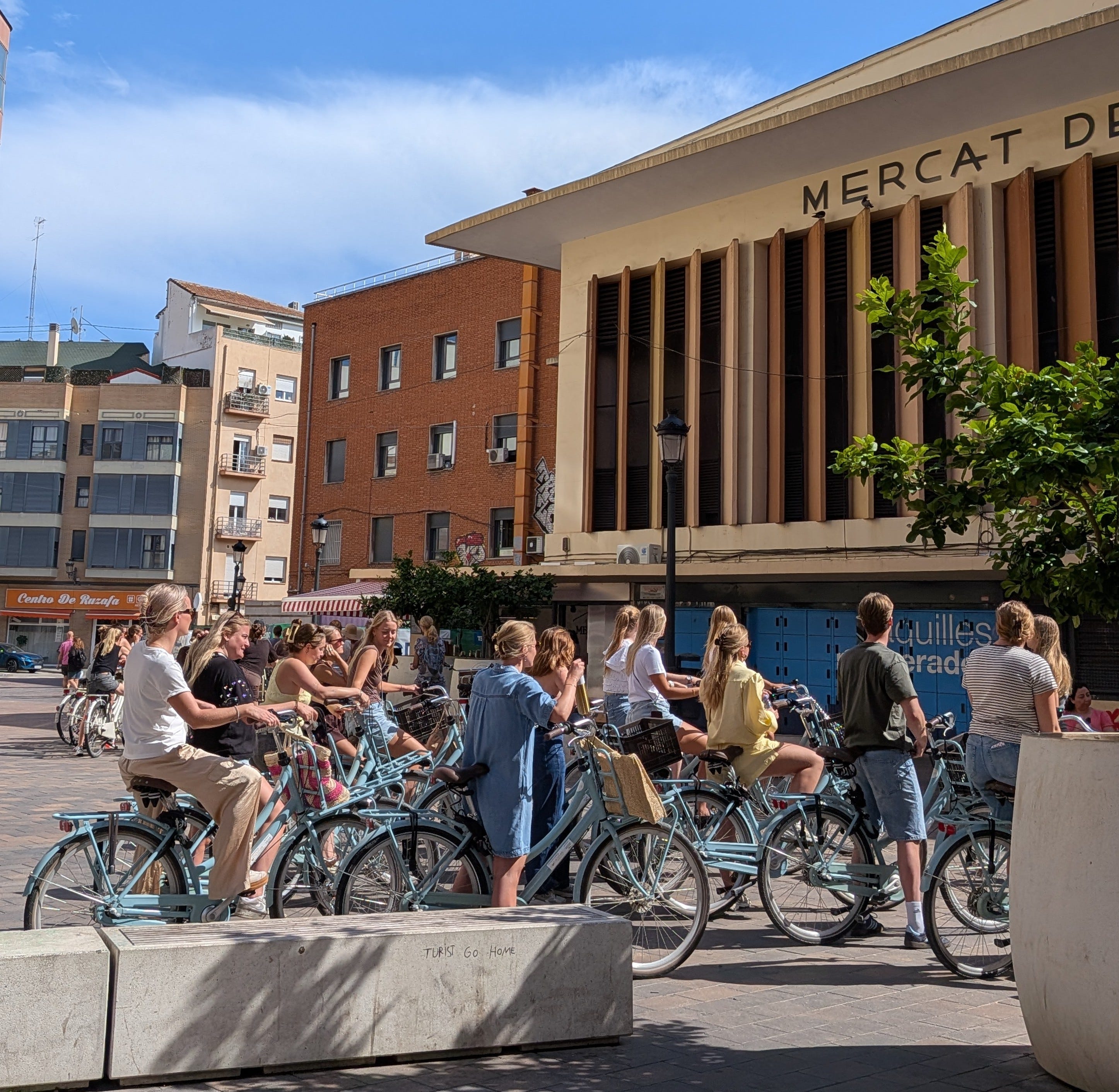
Dime store anti-tourism activists who act as if everyone who isn’t “local” has means in a sea of locals who are all “poor” and barely subsisting on “Spanish salaries” have hit a new low. There’s something especially condescending about categorizing a swath of society as “poor locals” to be romanticized, then assigning that categorization to an easy-to-hate other.
And this whole tourists are bad and they’re the reason why my city is gentrifying nonsense takes the complex issues of gentrification and housing affordability and gives them Donald Trump-like treatment. Some of the same people who claim to hate the guy—and proudly walk on the polar opposite side of the aisle from him—use strikingly similar logic and rhetoric. But, again, another story for another day.
Today’s story cuts deeper than we’re all tourists sometimes. That’s important, and it’s true. Some of the loudest voices on overtourism also talk about traveling the globe to eat food. While they’re not stampeding from a cruise ship to the nearest all-you-can-eat buffet, I don’t see how they can exonerate themselves from being part of the problem they’re apparently so passionate about solving. Or—crazy thought here—are they just spewing hollow bullshit?
I’m often reminded that we’re all tourists when I’m sitting in the plaza anchored by a 17th-century church in our neighborhood. For every moron who stops, poses, takes a picture for Instagram, and moves on, there are dozens of people who stop and appear in awe of what they’re seeing. Sometimes, they stop and take a picture together—maybe as a family or as a couple—or take pictures of one another. And you can see it in their eyes, they’re genuinely enjoying and appreciating the moment.
Not long ago, I was sitting on the beach in Valencia. A Latin American family next to me was on WhatsApp talking to—presumably—a family member. This man—who looked like a grandfather—couldn’t stop talking about the water and the beach. He was bragging—in a good way—about being there. It’s just cool to see people genuinely appreciate things.
When I saw the Eiffel Tower for the first time, I cried. Not because of the structure itself, but because I couldn’t believe my life had taken me to where I was that day. I’ve lived near major landmarks all of my life—Niagara Falls, the Golden Gate Bridge, the Hollywood sign—and I’ve always had an appreciation for them. There are people whose life’s dream is to see these things. Some never get to. Others save, travel thousands of miles, and then experience an emotional moment in front of something they’d only previously seen in photos or on television.
There’s a power in this stuff we can’t—or, at least, shouldn’t—deny. Realizing all of the above—and seeing some concrete variation of it in yourself—doesn’t mean you’re ignoring the problems of gentrification or high housing prices. Or even overtourism.
As much as one thing—the tourist taking a picture—has something to do with the other, it also doesn’t. Tourism and housing are connected. But they’re part of a complicated dynamic with multiple moving parts. We’re busy fighting with one another over a series of rational and well-intentioned individual choices we all make, when the real problem sits with our leaders.
Paris had a mayor—Anne Hidalgo—who wanted to drastically reduce automobile traffic. She spent more than a decade using public policy to take space from cars and give it to pedestrians, cyclists, and public life. She had the political will and some support. Nobody was going to stop her. And they didn’t. The result was a smashing, against-all-odds and assumptions success. And it made Paris what should be the world’s urban planning model.
Likewise, if cities really wanted to crack down on tourism and lower housing prices, they could and would. They’d implement restrictive policies that capped tourist accommodation inventory, increased long-term housing inventory, and put a hard cap on prices.
But governments don’t typically do those things. Even the relatively good “social democratic” governments in places such as Spain. Because they have economic conditions to mind. They have interests they’re—for better or worse—beholden to. From corporations to businesses to property owners. As they attempt to strike a balance, they’re always going to err on the side of caution. And the side of caution resides with the bigger money as it scales down from the corporations to your mom-and-pop landlord.
So, left feeling helpless in the matter, the easiest person for everybody else to yell at is the tourist rolling a suitcase down the street. You can make the case that many of the suitcase rollers are idiots—maybe even bad tourists—but they don’t deserve the brunt of the anger on gentrification and housing. The negative effects of neighborhood change have been taking place in cities around the world for decades. And they won’t get properly fixed until governments act the way Paris did against cars. Tourists going home and staying home isn’t the answer; in fact, it might prove counterproductive.
Isolationism and keeping the other out doesn’t work; just ask the United States.
This and all of the other messes the world is in are enough to make even the most optimistic feel helpless, bitter, and jaded. The last thing we need to do is remove the simple joys we all experience at one time or another from the equation of life.
Most of the time, individuals aren’t actively trying to hurt one another. They’re merely doing their best inside a system designed to have—that needs—winners and losers with local, regional, and federal governments ultimately deciding who’s on either side of that divide.
Fight over the system that makes shitty and seemingly impossible rules for society. But let the family take the picture. Let the grandfather brag about the beach. And let the guy from Niagara Falls cry in front of the Eiffel Tower.
You can keep reading for free if you’d like. However, I’d appreciate it if you pay. This is what I do for a living—writing is not my side hustle.


I cried when I saw Van Gogh's "Starry Night" painting in NYC. It was truly an emotional "wow, I'm really standing in front of this work I've only seen in books, pictures, and even legos." I did not take a photo of it. There are loads of higher quality photos of it out there. I simply enjoyed being in its presence, soaking in the energy that Vincent infused in it.
And yeah...tourists aren't the villains. It's much more complicated than "blame that fat rich white man"
So, as I write, I am sitting in our home away from home in golf community of Pearl Valley. Amazingly happy that we are here and that we have been able to reset our "early and part-retirement" in such an amenable way.
I'd attach a picture or two if only I were allowed to :)
Tourism for a real purpose has to be a good thing. When say, the Bon Jovi tour comes to your city, that brings in money over a short time. Same in Liverpool every time the Reds play at home. And in some way, it is controllable and manageable.
Alongside, we need good management at the federal, district and city levels. That requires managing for all. The city of Zurich, near where we used to live, has got it so wrong that large firms are turning their backs on the city and the canton. The "management" is still spending freely on lots of projects, including huge amounts buying up real estate.
Some single-mindedness of the Hidalgo variety is I am sure part of the mix. Good management knows it needs more than one ingredient.