
Why Americans Plan Their Lives Around Comfort and Convenience
Drive-through banks, pharmacies, and coffee!

If you’re a monthly, annual, or founding subscriber and would like to lend additional one-time support, you can do that via Stripe below.
Your support helps keep this work independent, allows me to continue writing about life and urban form on the ground in Spain, and expand my writing to cities beyond Valencia—such as Paris all this month.
In fact, May’s stories will focus on France!
The perfect weather paradox. Weather becomes the gatekeeper.
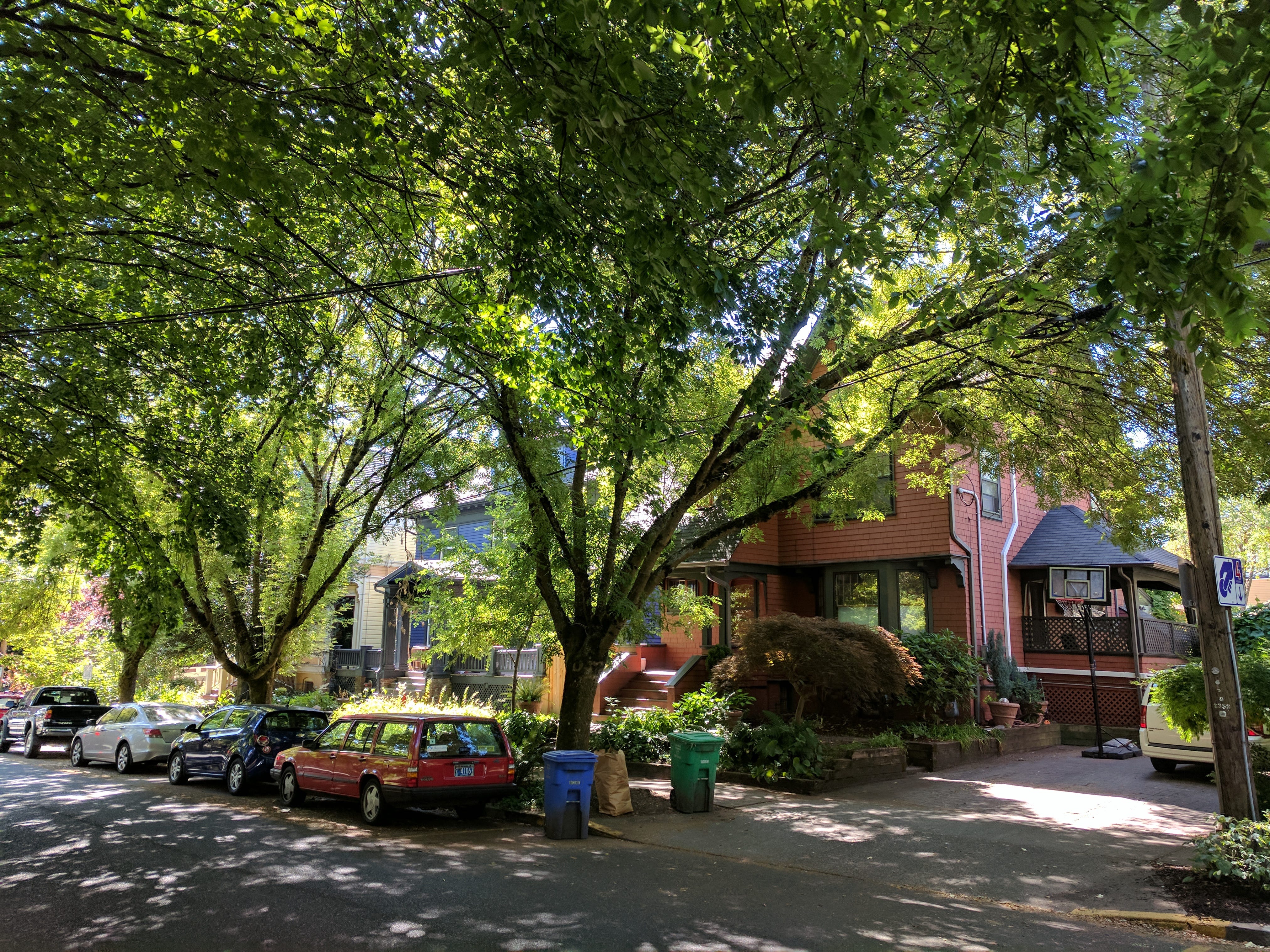
I remember walking on NW 23rd Avenue in Portland.
It started to rain. A drizzle strong enough to qualify as light rain.
That’s how it rains in Portland, Oregon!
And when it does—when you’re walking on NW 23rd and it starts to rain—you’ll notice that most people don’t do anything.
They don’t leave their outdoor café table. They don’t open an umbrella.
Maybe—just maybe—they zip their fleece or pull up the hood on their Patagonia.
People still ride bikes and run errands. They live life.
The Portland I remember is a little bit like the San Francisco I lived in.
Weather didn’t dictate the terms or pace of life. I mean, maybe a little, but nothing like it does throughout much of the rest of the country.
I have a few theories on all of this and thoughts on how it connects to what I’m seeing and living in Spain.
Despite the trademark that “it rains all the time” in Portland or that San Francisco is foggy, these places don’t really have extreme weather.
They have strong defining climate characteristics that often leave out other common elements that pop up frequently and often unexpectedly. Like, for example, it’s often quite windy in Portland and, especially, in San Francisco.
Climate is what you expect. Weather is what you get.
Any bad weather in places like Portland and San Francisco establishes itself as the baseline. If that’s normal, it’s nothing new and you have no choice but to do what you do regardless of what’s happening—or what ends up happening—at any given time weather-wise.
In places with extreme weather—I don’t mean isolated and sporadic extreme weather events; I mean extreme seasons—it’s a whole different game of ball. When winter comes in the Northeast, you really have no choice but to change the way you do life and, sometimes, change plans on account of the weather.
In places with seemingly perfect weather—I’m talking cities like Los Angeles where, apparently, it never rains and it’s always sunny—I’ve observed an opposite effect. Any little change in weather produces a sensitivity that I have to say turns people into babies of the spoiled brat variety. A little drizzle and people flee from outdoor seating as if a tsunami is rapidly approaching.
It’s the perfect weather paradox.
When conditions are ideal most of the time, people begin to expect them to remain ideal all the time.
Any small disruption suddenly feels intolerable.
You see it in LA. A few drops of rain can feel like a civic emergency. Outdoor plans get cancelled and traffic becomes even worse—life pauses.
It’s interesting because cities in Southern Europe technically have what many Americans would also call perfect weather.
You could say we have “perfect” weather in Valencia.
Warm, sunny, Mediterranean.
But the reaction to weather here is completely different.
A cool evening doesn’t empty café terraces. A bit of wind doesn’t stop people from walking across the city. A drizzle doesn’t send people scrambling indoors.
Unless it’s really coming down, people adjust.
They grab a jacket, shift their chair slightly under the awning, and keep talking.
Life continues.
This difference might seem trivial, but it reveals something deeper about how societies organize daily life.
In much of the United States, comfort and convenience are treated as fundamental requirements. Systems are built to eliminate friction wherever possible. And even when they don’t actually make life easier, many people—including quite a few outside the United States—still cling to the myth of American convenience and efficiency.
Drive-through banks, pharmacies, and coffee!
Always a place to park your car—often for free.
Indoor malls. Climate-controlled everything.
The goal is simple: remove discomfort and perpetuate the myth that your nation is a well-oiled machine—even when the evidence increasingly shows the opposite.
And when controlled conditions morph into a little bit of unavoidable discomfort—bad weather, a longer walk, a slight inconvenience—it feels like something has gone wrong.
Cities like Valencia, Barcelona, Rome, or Lisbon operate on a different assumption.
Life will involve small amounts of friction. You can’t engineer yourself out of it. And why would you want to do that anyway? The more infrastructure you create to accommodate American-style comfort, the bigger the machine you have to manage.
Soon, you’re just playing Whack-a-mole on endless inconveniences and calling it progress.
And once you start building a society around eliminating discomfort—a large part of which is a focus on the private automobile and private space—something else happens.
Life migrates indoors.
Errands in climate-controlled environments. Socializing inside restaurants, houses, offices, and shopping centers. Public space becomes something you move through rather than something you occupy.
Weather becomes the gatekeeper.
If conditions aren’t perfect, people simply stay home.
In cities where people accept a little friction, the opposite happens.
The threshold for participating in public life is simply lower.
And that difference has enormous consequences for how cities feel.
When people require perfect conditions, sidewalks empty, streets stay quiet, and public life shrinks. In many places, that has already become the baseline—a direct result of American society’s obsession to engineer comfort and convenience.
Yet, the futile effort persists.
In cities built to accommodate people in public under a variety of conditions, daily life simply continues outside.
When people tolerate imperfect conditions and the goal isn’t to anticipate and eliminate them as if they’d be a public emergency, public space actually exists and stays active almost all the time.
The city never really shuts down.
Over time, this becomes self-reinforcing.
The more people remain outside, the more comfortable everyone feels being outside. Streets stay lively. Neighborhoods feel safer. Public space becomes the shared living room of the city.
And it starts with something surprisingly small.
Not expecting the weather—or life—to be perfectly comfortable.


If life stopped every time it drizzled in PDX, people would never leave the house!
Where would we be without our interest in the weather?
Since we moved down to South Africa, my wife who loves to look at the weather forecasts, has learned that down here, actual weather will differ a lot from the prediction. We left home at 0800 today; overcast, maybe 18/19C. By the time we got to our club for PickleBall, which is 50 mins away, sun was out, we are back at 25C, and sweating on court.
As the Scot’s say: there isn’t really bad weather, just bad clothing