

Over the last few months, we’ve discussed the importance of developing a real understanding of what your day-to-day life will look like at your destination when you think about moving abroad. The idea is to establish a strong level of certainty with respect to the physical environment you’ll be living in.
Today’s post requires a bit of context to ground us in reality AND ground the discussion in other big life changes beyond moving abroad—such a retirement, going self-employed, or just starting over.
If you want writing that dissects the hard parts instead of rushing past them, subscribe below. And if you’ve supported this work for a long time and want to help sustain it as it deepens, that support matters.
Some people get so obsessed with leaving the United States as a political statement—and, increasingly, I can’t blame them—that they gloss over an important fact: Your politics—or anything that’s emotionally charged—quickly becomes close to, if not irrelevant when you move to a foreign country.
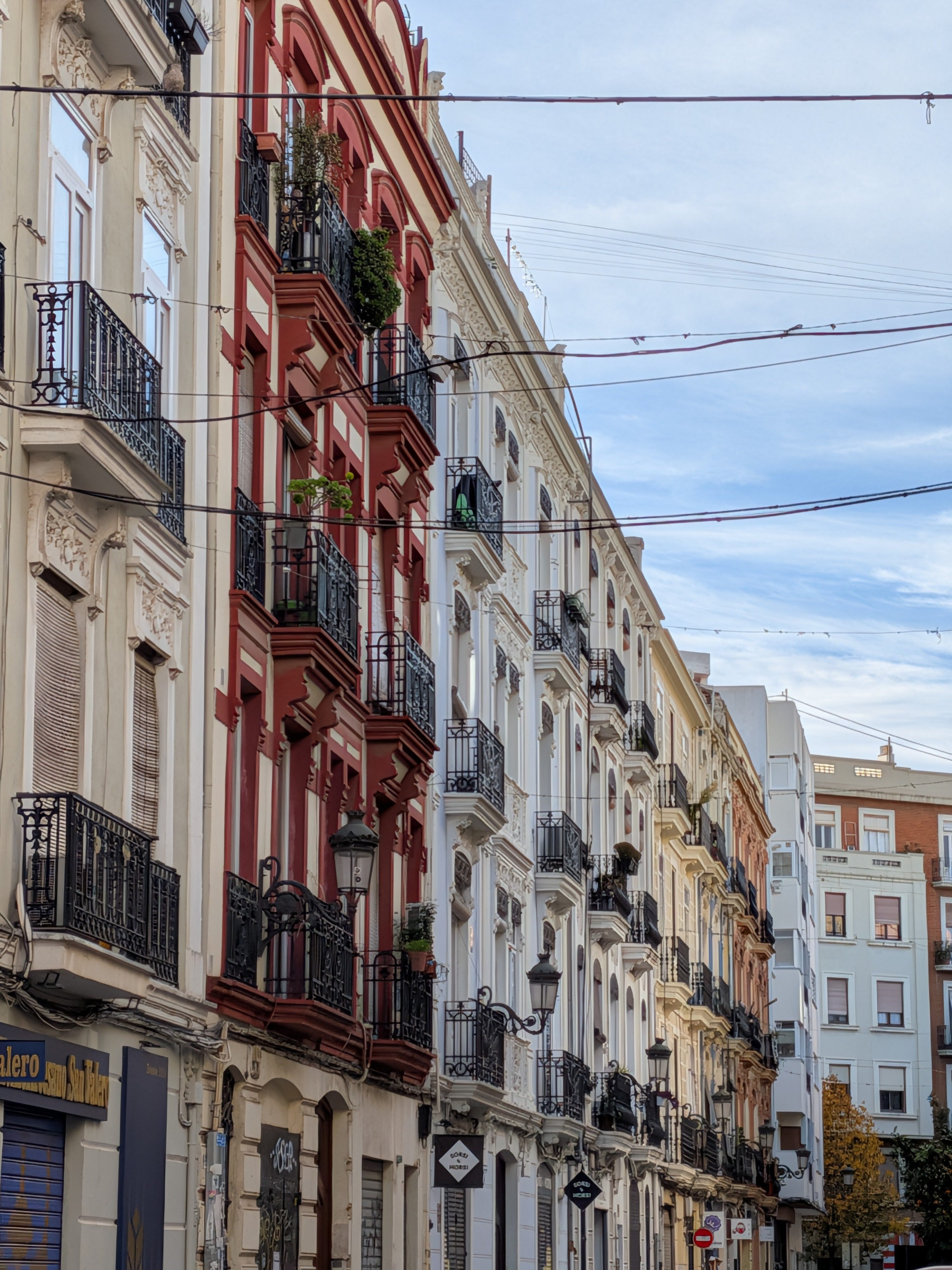
I hate cars, but they still have them here. I’ve just set myself up to never have to drive one.
Along similar lines—
Sure, “they” (some people) “hate Trump in Spain,” but they don’t wear that hatred on their sleeves like liberal Americans do. And the reality is that if Spain held an election today, the right wing would gather nearly half of the vote—with the far right clocking in at an estimated 17.9%, thanks to strong support from 18-to-24 year olds.
Spain looks a lot like the United States politically. Yes, we have a social democratic (left wing or left-leaning, depending on how you look at it) government in power right now, but you still have a situation where the big cities are liberal bubbles and many of the smaller cities and towns are conservative, prone to the allure of populism, or both. More young people are going far right and the 65+ crowd tilts strongly—the U.S. equivalent of what used to be—conservative.
There’s more context and more to say on this, but that’s not my job—thankfully. However, the political reality is important because—again—when you get here, you’ll quickly find you’re in pretty much the same political geography you left.
So—with that important groundwork laid—if and when you leave the United States, you need to be certain about the place you’re moving to. Not as a political paradise, but as an environment where you can create routines you absolutely love. Not as a fantasy you have after vacation or while scrolling social media. As in—you know the mechanics of places and how they help dictate how you tick, which naturally and logically leads you to choose the best one. You could write a 20-page paper on why this or that place.
Bottom line—you have to be able to get around, run errands, and participate in public social life in a way that makes you happy.
If you’re unable to do that in the United States, it’s not because of Trump. It’s because of land use decisions—rooted in politics—that were made long before he got into politics. His only role is that he’s making just about everything worse.
If you move, you’re not escaping politics or even car dependency. You’re escaping a much larger, very specific sociocultural environment shaped by long-term decisions.
Without destination certainty detached from your politics, you won’t be fully equipped to deal with the psychological uncertainty you’ll most definitely face—whether you relocate to a city, small town, or the idyllic countryside.
It’s no different than retirement really. Where are you going to live? Will the place facilitate the retirement lifestyle you’re certain you want to lead—logistically, socially, publicly?
With that set, the work begins on the uncertainty that sets in when the systems, structures, and people who once validated your every move—even if only in the background or in your head—no longer play the same role as your emotional gatekeeper.
So, it’s a clear path—
Certainty in your destination so you can deal with the uncertainty when you get there.
You don’t move to escape uncertainty. You move so uncertainty shows up in a form you can live and grow with.
I’m convinced this assessment applies to a vast majority of people who have moved in recent years or are at some stage—conceptually or logistically—of relocating abroad.
However, there’s a group of people who we don’t talk much about on these pages—the people who can thrive figuring it out as they go. This can work only if extreme uncertainty is something you actively seek, not something you hope to escape. For most everyone else, “figuring it out” is usually just poor preparation dressed up as openness.
There’s a massive group of people stewing over things like Minneapolis right now who think they should move abroad, but would suffer tremendously if they did. They have zero basis for moving other than the fact that they’re pissed. Being pissed isn’t the straw that broke the camel’s back or the thing that pushed you over edge. It’s not sustainable.
There’s a large enough group of people who are convinced that they can figure it out as they go.
I used to think I could function well on 5-6 hours of sleep. Then, I experienced what getting 8-9 hours of sleep feels like. For whatever reason, we all like to think we’re the type of person who can… (do whatever) when we’re really not. It takes a special breed of cat to be able to deal with destination uncertainty and psychological uncertainty at the same time.
Wanting to be that person doesn’t make you that person.
I need a home base.
I need a place where I feel part of the ongoing, ordinary theater of life—not because I “belong,” but because I participate. Where my routines exist not to limit me, but to support me. Where I can control enough of my environment to stay grounded while I deal with the parts of this life that are inherently uncertain.
I admire people who can live without that. The real digital nomads. The ones who aren’t performing flexibility but are actually wired for it. People who don’t need a return point to feel oriented. They exist. They’re rare. And most of them figured that out about themselves long before they ever crossed a border.
Admiration doesn’t require imitation.
Knowing who you are—and who you’re not—is part of the work.
For most people, “figuring it out as you go” isn’t adventure. It’s avoidance. It’s skipping the hard, unglamorous work of deciding what kind of life actually suits you and being proud of your thoughtful decisiveness.
Real improvisation only works when it’s grounded in self-trust, not fantasy. When uncertainty is something you seek, not something you hope will magically resolve itself once you leave.
That’s the distinction almost no one makes.
So the question isn’t whether you can figure it out as you go.
It’s whether you’ve already done enough figuring to know when—and where—that approach actually works for you.
Well said, Rocco. While we stand on opposite sides of the aisle, I completely agree with you. Politics is important, but are not the "end all, be all." We must still plan for our future and our childrens' futures. I have lived a significant amount of time overseas, which is why I love America so much. However, I always have (executable) plans to move overseas if needed. If we do have to move, it will be a logical, well-thought-out event, not an emotional one.
I can readily identify with the preference not to have a double uncertainty of both place and psychology.
I add that there is something here to consider. I would say that the thoughts shared here are about changing countries generally, rather than being specifically about moving away from the United States.