

When my wife’s 22-year-old daughter visited last year, she went outside to call her friend at like one in the morning.
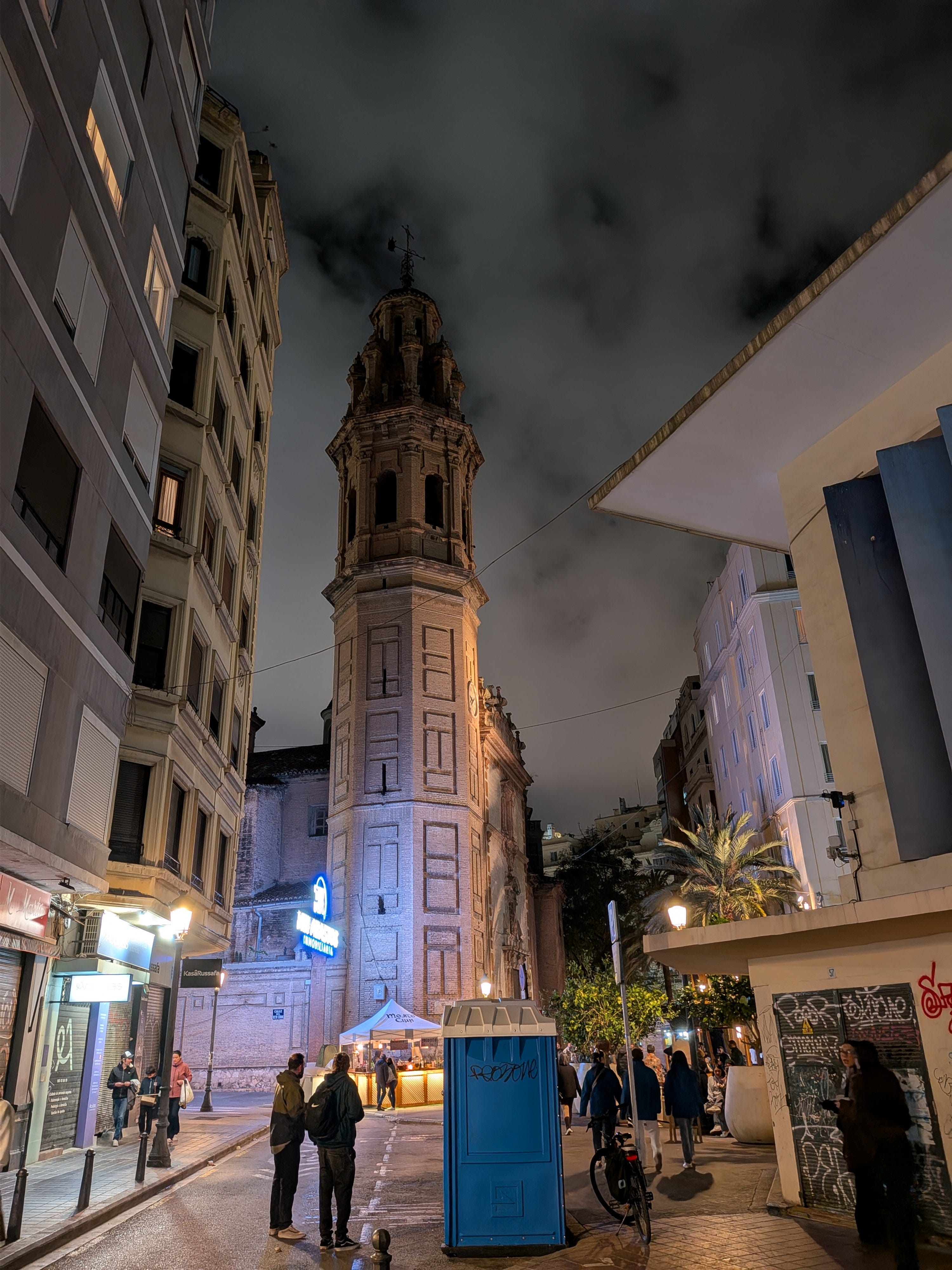
She didn’t step outside nervously or check the street first. She just walked out the door, found a bench, and sat down.
After a few minutes, it dawned on me. I also didn’t think twice that she was in the neighborhood—sitting on a bench—after dark. In Los Angeles, it never would have happened.
She has the sense not to sit outside her apartment—or our old one—in LA late at night. Even during the day you have to be careful, especially as a young woman. Hell, even as an old man I was often looking over my shoulder.
The Valencia reality is made possible by a number of things—virtually no guns, considerably less violence than other societies, and the always-present eyes on the street.
And also: actual places to sit. They’re few and far between in Los Angeles.
Urbanist Jane Jacobs coined the phrase “eyes on the street” decades ago. In neighborhoods where daily life happens in public—people walking, sitting at cafés, chatting on benches, heading home from dinner, taking evening strolls—there are always informal observers. Not police or security guards, just ordinary people going about their lives.
That constant presence creates a subtle form of social supervision.
Streets feel safer because they’re active. When many different people share the same space throughout the day and into the evening, the street polices itself.
So it’s no surprise that in addition to an endless number of young people like my wife’s daughter—alone and in groups—you see a mix of people that would just look weird in many other places.
Every single day and night when you go outside, you see kids playing after school—then, often again—late at night, older people sitting out or strolling, and families lingering.
A diverse mix of ages, ethnicities, and purposes.
It all comes back to something we discussed last week that bears repeating:
The mixing of everything.
Most often cited—the mixing of uses. Of course. Residential, commercial, offices, public services and public space.
But also—
The mixing of locals and tourists. The mixing of people from Valencia, elsewhere in Spain, Latin America, other parts of Europe, from Asia and Africa, the United States, and the rest of the world.
The mixing of ages—kids playing soccer, riding scooters, and running around the plazas and streets. Adolescents alongside young parents, old(er) parents like me, single people of all ages, and—maybe most important—seniors. Everyone is present, accounted for, and looked after by the built-in eyes on the street.
The mixing of establishments—cafés, bars, and restaurants that range from inexpensive “old man” bars to higher-end cocktail bars, from classic Spanish bars and cafés to coffeehouses that could easily be part of the landscape in places like Brooklyn, from €6 almuerzos to €15 menús del día to several hundred euro meals at Michelin star restaurants.
When this kind of mixing sits at the organic and engineered heart of urban planning, you almost have to try not to create busy and vibrant streets and plazas.
If you ever wonder why the United States—by and large—doesn’t have the type of street and plaza life as Spain, it’s because of the car—absolutely—but also because, in most of the country, you’re not allowed to really mix anything.
And when you try to mix uses—and, sadly, even people—there’s often staunch opposition, even in some of the nation’s best cities.
The mixing of everything makes everything else possible—safety, proximity, easier access for seniors, very little helicopter parenting.
The real benefit of this kind of environment is better urban design that makes for livelier streets and a different way of living.
In places like Valencia, nobody is pushed out of the public realm because of their age, their schedule, or their stage of life. Everyone simply occupies the city together.
That does something powerful to the way a society functions.
It reduces fear and isolation. It makes daily life feel less controlled and more free.
When children can play outside, when young people can sit on a bench at one in the morning without anyone worrying, and when older people remain visible in the life of the neighborhood, the city loses its hostility and feels like a place you belong.
That’s the real promise of good urban form.
Not just better streets or better plazas.
A society where everyday life happens together—and diversity isn’t just a buzzword.
We’ll be in Paris for the entire month of April.
We’re going to do our best to pretend we “live there,” even though that’s not really possible because we live someplace else.
But the plan is for me to work in the morning and for us to walk many kilometers each day throughout Paris.
In May, I intend to do a dispatches from Paris series constructed from notes I take during our time there.
Subscribe now to ensure you don’t miss any of that. I’m excited about April.
More mixing, mixing it up, and mixed-use buildings, please! Some people up here get it, but "mixed use" has become a 4-letter word. Part of that is an aversion to apartments as a form of housing density, but part of it, I think, is just a general fear of change. It's a wild dissonance that laments a local bar/store/whatever closing while also loudly condemning any new businesses coming in to fill the void.
My first reaction was “of course”. The second was: “Glad Rocco reminded us.”
In Zurich, near where we used to live, mixing alone has not been enough to make late night mingling and strolling super safe everywhere.
Zurich specifically and Switzerland generally ha too much imported crime; many people who have nothing to lose by doing things which our culture abhors.
So design matters and so does good police work. More of what in NYC and I think later in LA was called the broke windows theory.