

For an American, it’s a foreign if not preposterous concept—the idea that you would buy all of your groceries somewhere other than the supermarket, Costco, Walmart, or Target.
In some parts of the United States, a massive Walmart store is the only actual option. In more than a few large metros, the supermarket or supercenter is the only affordable or financially sensible option.
As you might know, I love grocery shopping. Loved it when I lived in Los Angeles. Love it even more here in Spain. However, as I become better acquainted with my neighborhood municipal market and local stores—bakeries, bodegas, bazaars—it’s becoming clear. I might be able to completely cut the supermarket out of my life.
What surprised me wasn’t the supermarket itself—it’s great here. As expected. It’s that Valencia’s local food network is so coherent it might make the supermarket optional.
For the next few days, all How It Works (and Why It Doesn’t) subscriptions are 50% off.
And if you pay in euros—which helps me build the euro-denominated life I’m writing about—you get 30 days free. After your initial subscription processes, I’ll tack on a month. So a monthly plan gets a month free and a 12-month subscription becomes a 13-month subscription.
No gimmicks, no countdown clock. Just a way to say thank you and to bring more of you into the work I’m building here in Spain. To get the deal, follow this link or the button below.
The reality is this—as much as I love the supermarket as part of my near-daily routine of grocery shopping, I now love the other parts of the routine more. That’s because the systems in Spain allow me to expand that routine and buy things that were either unaffordable or not justifiable in Los Angeles.
This deep dive into the dynamics of grocery shopping—(I hope you’re a geek like me about this stuff!)—isn’t nostalgia or romanticization. It’s about how a place—and the systems that operate within it—work so well that they can change the seemingly mundane of your day-to-day.
We’ll get into the specifics of what I buy and where I buy it in Spain versus what I bought (and what I didn’t buy) and where I bought it (or didn’t buy it) in the United States. And we’ll consider the nuance of the situation alongside the probability that I can do 100% of my shopping—or close to it—at places other than the supermarket.
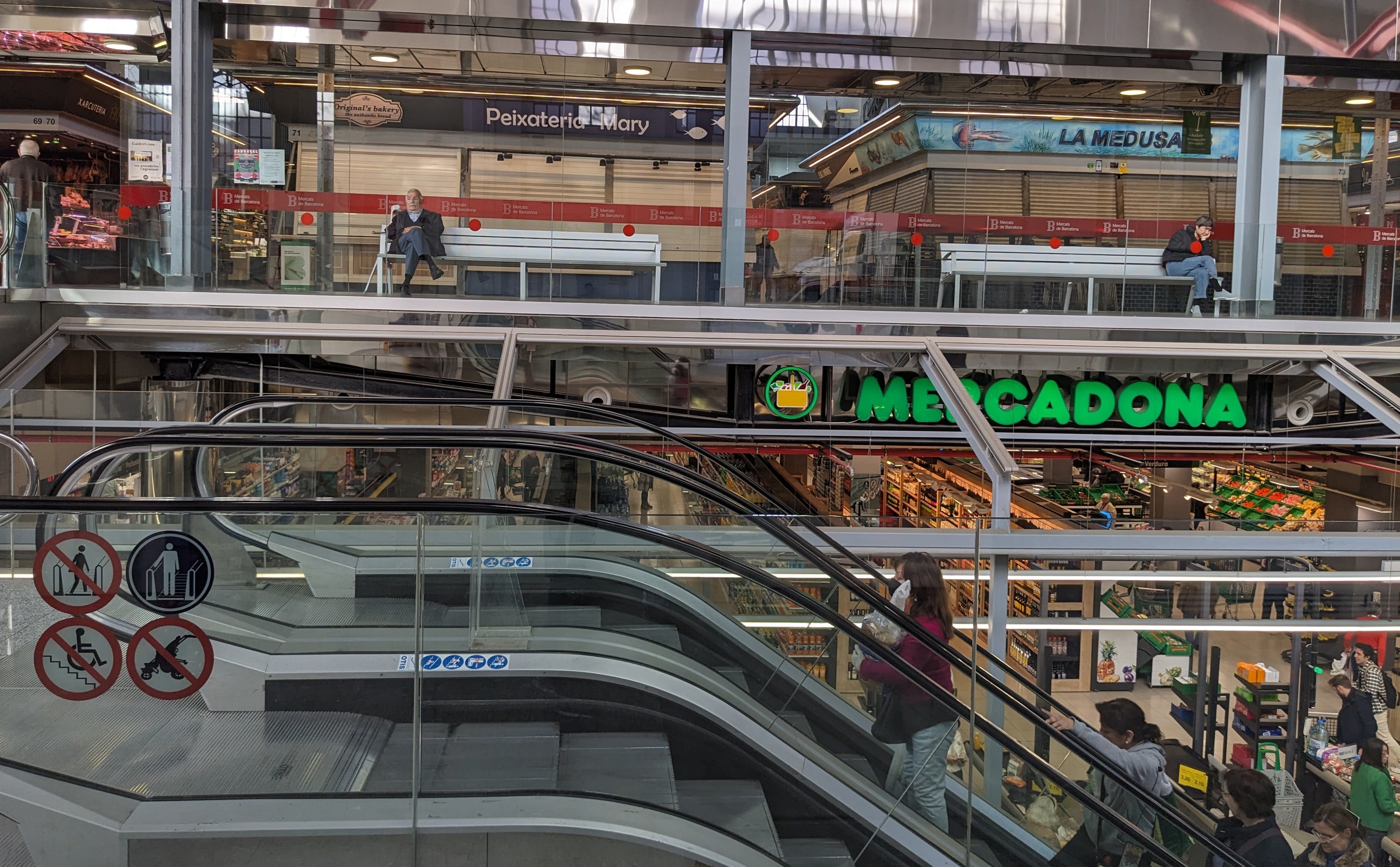
The Local Food System of Valencia (Russafa Edition)
Spain has a ton of supermarkets. In fact, it’s a supermarket nerd’s wonderland.
The two I go to several times each week—Mercadona and Consum—are Valencian companies. So—on one hand—you’re supporting local businesses and families, albeit large corporations. But they remain chains, and for reasons we won’t get into here, chains leave a considerable bit to be desired.
Right now, these are the items we regularly purchase at Mercadona and Consum:
Milk
Greek yogurt
Granola
Butter
Cheddar cheese
Dried fruits and nuts
Tuna, sardines, and other canned fish
Hamburger buns
Tortillas
Potato chips
Cookies
Sparkling water, beer, wine, liquor
Toilet paper, paper towels, and assorted hygiene products
Laundry detergent, dish soap, sponges, kitchen rags, cleaning products
We buy all fruits, vegetables, olives, olive oil, balsamic vinegar, tea, chicken, beef, pork, bread, plus some cheese, snacks, wine, liquor, and a handful of household products at a mix of our municipal market, a local bakery, local shops, and bazaars. We buy our coffee from Amazon because we can’t find the type we need anywhere.
In terms of the cost split—in November, we spent:
€252.40 in places other than the supermarkets—primarily Russafa Market and the local bakery.
€243.37 in Mercadona and Consum.
So, almost a 50-50 split.
However, we’re making an exponentially large number of visits to the neighborhood market and local bakery. And we’re using—to make meals at home—more ingredients from these places. That said, a few considerations as we advance this analysis:
Roughly half of that supermarket spending is on household and hygiene items. You can actually buy most of this stuff at the municipal market. My assignment over the next few weeks is to find out how much more it would cost us to shift this spending. Or—you never know—would we spend less? You’d be surprised how often local, neighborhood-level vendors remain competitive with or charge less than the supermarket chains.
I also need to investigate further the actual food items on that list. At this point, I know that the Greek yogurt we buy—and love—from Mercadona costs about €3.00. It’s double that at the Greek stand in the market. I need to keep looking. I am willing to pay a little more for better quality and to support truly local business, but if all of the other things on our list are double the price, it might not make financial sense. Plus, we’re already doing our fair share of neighborhood-level spending. I will do more searching on these two points and come back with an update.
There are items we never or rarely purchased in the United States—cherries, many nuts and dried fruits, specialty tea, some cheeses, and really anything other than a handful of fruits and vegetables at the farmer’s market. The prices on those things—especially nuts and meat at the farmer’s market—were nothing short of insane.
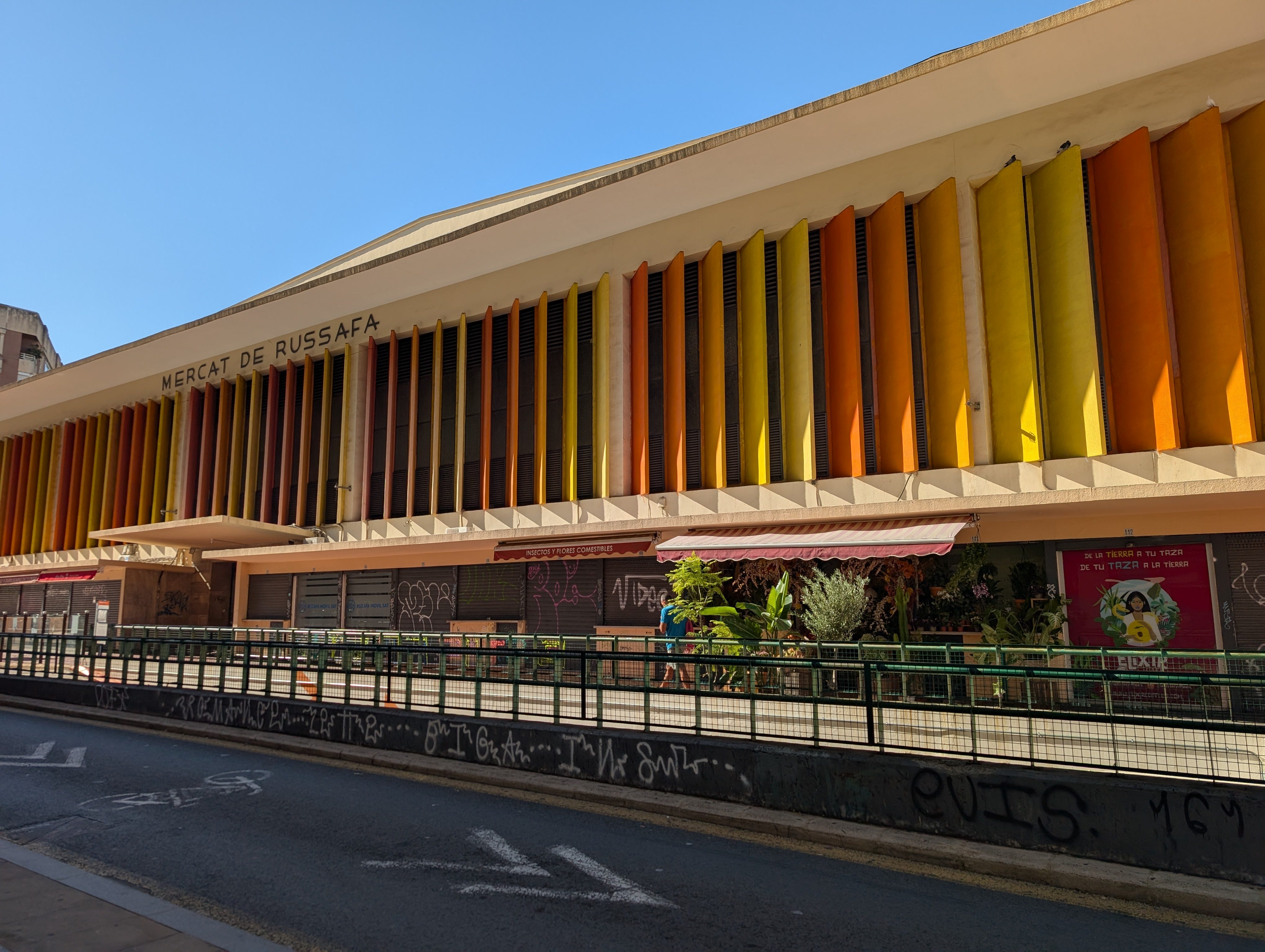
Russafa Market is not a “cute” European market. It’s a functioning distribution system that serves the local community and larger area. It’s the backbone.
Our neighborhood municipal market has the following attractive characteristics that matter in our day-to-day and for the greater community good:
Generational vendors
Direct buyer relationships
Regional producers
Seasonal availability
Built environment that funnels foot traffic
Prices shaped by proximity, not luxury
Broad selection even without supermarket-style abundance
Mass-market items available—just not consolidated into one store
Taken together, some things are genuinely cheaper at Mercadona and Consum. Some things taste the same or are identical. Some things I never expected to be able to buy at the municipal market. I am discovering more of these things with almost every visit.
It’s not about perfection or ideological or moral purity.
I’m doing this because—for me—it’s fun. I genuinely enjoy grocery shopping and the hunt. In Los Angeles, I needed a freaking app to make it feel close to affordable. If I can support neighborhood businesses in the process without wrecking my budget or sacrificing quality—why not?
In Spain, this is part of what I mean when I say the calm is built into the culture or that Spanish society is actually more convenient and efficient than American society. The idea that the United States is this advanced nation of convenience and efficiency is a myth perpetuated by the government, corporations, and an indoctrinated society.
Neighborhood-level, local/regional, no-car-needed systems for shopping—and so much else—in Spain mean:
Less stress
More routine
Seasonal learning
Vendor relationships
Better quality at reasonable prices
Less decision fatigue
Days that fit together better
The American counterpoints:
Driving to Whole Foods or Costco
Parking lots
Car dependency
Higher prices
Scant functional small-store infrastructure
“Local” options treated as luxury
Markets as weekend events
Very little neighborhood/local-level production and distribution
And this is where the system-level difference becomes impossible to ignore. In Spain, the supermarket exists inside a larger ecosystem that supports it. In the U.S., the supermarket is the ecosystem—because everything around it collapsed or never existed to begin with.
I didn’t truly understand any of this until fully settling in Spain. You don’t realize how much a supermarket-centered system shapes your daily life until you step into a place where it doesn’t have to. The shift isn’t a choice—it’s what happens when the surrounding structure finally supports you.
Why the System Feels Different—and Why It Works
A system either supports your routines or forces you to work around them.
In the U.S., you organize your life around the supermarket because nothing else is available, affordable, or reliable. In Valencia, the opposite is true: the system makes multiple smaller, more specialized options possible—sometimes cheaper, often better, and always closer.
That structure not-so-quietly changes your day:
You shop more often, but spend less time doing it. And the time you do spend is more quality time—having interactions with people you could literally come to know for decades.
You walk to buy bread instead of driving across a parking lot.
You pick up fruit on the way home instead of “making a trip.”
You buy meat from a place where someone remembers that Monday night is hamburger night in your house.
You don’t plan around scarcity. You plan around proximity and the inherent joy of eating and drinking well and doing your small part to support the people who enable such a high quality of life.
The path of least resistance is also the path of higher quality, lower stress, and greater connection.
This is what makes the supermarket optional—not ideology or trendiness.
And it’s what makes me think there’s a world here in Valencia where I never step foot into a supermarket again. That’s something I never necessarily wanted or thought I’d hear myself say. It’s something I enjoy working on and—as promised—expect an update soon.
The Myth of the Honeymoon Period (But Let’s Actually Be Honest About It)
People love to tell you the “honeymoon period” will wear off. They say it with a kind of smug certainty, like they’re delivering wisdom instead of revealing the limits of their own imagination.
But the honeymoon period only exists in systems that are hostile by default.
It exists in cities where:
the car owns your body,
the supermarket owns your wallet,
and the culture tells you convenience comes from size, not proximity.
Eventually that breaks your will and puts you in a perpetual state of cognitive dissonance. There’s a honeymoon period when people move to suburbia for “more space.” It’s just not a thing in great urban neighborhoods, particularly if you love city living and favor proximity.
The only way to survive the American way is to cling to novelty whenever you can find it. A new job, a new relationship, a vacation, a different coffee shop. Anything to numb the background hostility.
So of course people think Valencia is a honeymoon.
They’re confusing relief with novelty.
In a functioning system, there’s no high to come down from. You’re not dazzled— you’re aligned. You’re not escaping—you’re finally living inside a structure that doesn’t fight you every step of the way. A structure that doesn’t punish you for existing, or for wanting a life built on proximity, routine, and common sense.
And this is where the “honeymoon period” line always shows its hand.
Americans come to places like Spain, see how the quality of life is decisively higher, and have no psychologically comfortable choice other than to package it as novelty. They go home and tell themselves—and everyone else—that it was great, but “there would be a honeymoon period” if they stayed. As if real life isn’t being lived every minute of every day in Spanish and other European cities.
It’s a defense mechanism.
Because acknowledging the alternative means acknowledging that the motions they’re going through are grinding them down every single day.
And the same thing happens to people who move here and struggle. Instead of facing the challenge of learning a new culture and society, they blame bureaucracy or latch onto whatever myth keeps them from confronting the real issue: Spain works just fine. It works with them, and it worked—or will work—without them. What they don’t want is to adjust the parts of themselves that were shaped by a place that didn’t.
So they call it a honeymoon.
Because for a lot of people, admitting what’s really happening would require admitting something uncomfortable: that the system here works, but their life back home didn’t—and not just because of the environment. The people who move here and struggle aren’t being failed by Spain. They came looking for a solution to problems a place can’t fix.
They weren’t looking for a basic, neighborhood-level system that quietly does its job. They weren’t looking for proximity or a daily rhythm that softens the edges of your life. They were looking for escape. New scenery, new energy, a reset button that doesn’t actually exist.
So when the internal stuff follows them here—the dissatisfaction, the lack of direction and sense of self—they turn on the place. Instead of owning their own anxiety, they blame bureaucracy. They repeat myths about slow responses or inefficiency. And they fall back on the honeymoon idea, because it’s easier to say “Spain wears off” than to confront the possibility that maybe the thing that needs adjusting isn’t the country.
A functioning system can support you. It can’t replace you. It can’t build a life for you. It can only help enhance the one you’re capable of building.
For me, that’s always been neighborhood rounds, grocery shopping as sport, and walking through a city that rewards showing up in the smallest, most consistent ways. I loved that routine in Los Angeles even when the environment worked against me. Here, the same instinct finally has a place to land. Whether I ever cut Mercadona out of my life completely almost doesn’t matter. What matters is that I could.
Because when your surroundings function and you know who you are, the routines you build—even the mundane ones like buying milk or choosing bread—stop being something you fight through. They become the shape of a life you actually want to wake up to.
I have missed your comparison articles! Everything you described of the US is solidly real and becoming increasingly inconvenient as they try to incorporate technology into the most basic of tasks.
The newer generations were born into technology that we (GenX) didn't have when we were their age. So they do not see how unnecessary some things are. I can see if they were to go to an urban city in another country -such as Valencia, Spain- and not assimilate easily. Going from car dependent, to walking? Carrying your groceries while you walk home? Kids don't walk anymore, they ride electric scooters.. on the roads.. with the cars. It is mayhem.
I drive to three different grocery stores, once a week, on my 1-2 day weekends. Grocery shopping should not take half a day to accomplish, but it does, and stopping during the week can add hours to your work day. It is a pre-shopping hunt through apps and websites.. which makes it really un-fun. The newest thing are stores that make you use an app in-store to get a discount price. So not only do you have to get online to find the best prices before you shop, you have to get online at the store to "clip coupons" while you shop. They have QR codes on everything now. It's like a circus.
One new thing I have become aware of, the State has removed outgoing mailboxes. You have to drive to the Post Office across town to mail anything. The postal carrier does not check for outgoing mail unless he has mail going into your box -and sometimes not even then will he take it.
Making the extra effort to shop and buy locally is the right philosophy.
Not at any price though. There is a point where if there is too much of a premium to “go local” that you have to buy at the right price.
We tried hard with all the renovation and fitting out of our mountain place to buy locally. Largely, it worked.