

I read comments like this one from Medium and genuinely wonder if there's some joke everyone else is in on.
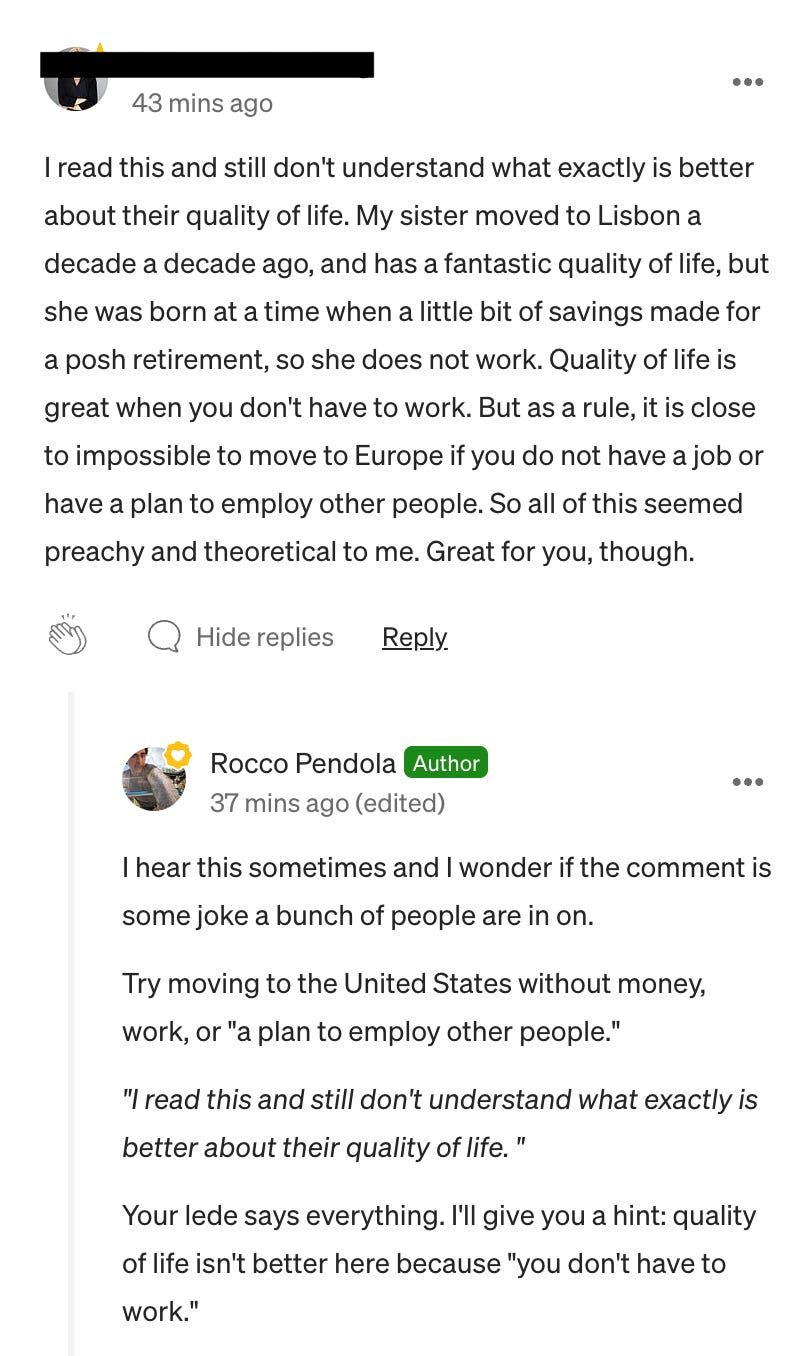
But it’s not a joke. And I’m not crazy.
Large swaths of Americans think like this.
Then, without the self-awareness to keep these thoughts to themselves, they say them out loud—reinforcing not only my birth country’s reputation, but its position and place in the world.
It’s almost hard to believe.
But it goes a long way to putting the conversations we’ve been having in this newsletter lately in perspective. And it makes me realize that they’re not all part of some mania unfolding in my head.
Sometimes I see things and I can’t stop thinking about them. Then I’m left wondering why others don’t seem to care as much as I do. This personality quirk (?) probably goes a long way to explaining why I do what I do for a living.
Sometimes it’s torture—thinking alongside existing.
We have to pick this comment apart.
The reality is that having money—not necessarily a lot of it, but enough to comfortably meet your day-to-day needs—puts you in a better position no matter where you live. This is how most modern societies function—for better or worse. This variable is related to, but still distinct from quality of life.
Many Americans would look at that paragraph and call bullshit. They would argue that having the money to buy a 5,000 square-foot home in a subdivision 40 miles outside of the dense and dirty city equals high quality of life.
That’s little more than a status play—not an expression of quality of life.
Money and quality of life aren’t the same variable.
One of the strangest things about living outside the United States is realizing that large numbers of Americans appear to believe they are.
The predominant American equation—that’s tough to shake after decades of indoctrination—is that:
Money → Status → Quality of Life
It’s as if the American dream is the end all and be all, even though it doesn’t even begin to address—
How much time do you spend in a car?
How much money does it cost to exist?
Can you walk?
Can you access public space?
Do you interact with people?
How much friction exists in daily life?
How safe do you feel?
How healthy is the food?
How much time belongs to you?
None of these variables appear on a balance sheet. They’re not part of the psychology of the American dream and—subsequently—the American experience.
We all know that the American dream is bullshit. So to transplant it to—for example—Spain in your mind or in practice is also bullshit of the highest, but most basic order.
Why would you want to? Why would you need to?
But that comment does. And it’s representative of how quite a few people in the United States—and around the world—think. The idea that money cements status and the combination of money and status equals living the dream amid a high quality of life.
It’s such thoughtless nonsense.
My wife and I didn’t move to Spain because we got rich.
We moved because we wanted to improve day-to-day life in other areas, directly related to quality of life.
Our housing cost—rent and utilities—is about 24% higher in Spain than it was in Los Angeles. That’s because of three factors: we were under rent control in LA, we didn’t pay utilities, and housing prices in Valencia skyrocketed after we decided to move here. Rent that we anticipated being closer to €1.000 is actually €1.500.
While we save in other areas of life—e.g., transportation and food—we spend the same way and pretty much the same amount in Valencia as we did in Los Angeles. We didn’t move here to optimize our balance sheet in the day-to-day.
Many Americans would have seen that writing on the wall and bailed on Valencia—maybe on Spain altogether. Large swaths of people avoid Spain because of the taxes. For the record, as a self-employed person, they end up being about the same as they are in the U.S. The fact that this scares people away just blows my mind.
Is your heart a calculator?
Or does it want what it wants?
We moved from a position of relative strength amid a low quality of life to change the core structure of the aspects of our daily life that are effectively impossible to change in the United States.
And that’s the part comments like the one that anchors this article miss.
Of course money matters.
Money allows us to live in Russafa rather than somewhere else. Money gives you options. It improves quality of life almost everywhere on Earth. But having enough money to exercise choice isn't the same thing as being wealthy.
And money isn’t the same thing as quality of life.
The real question is what your money buys you.
In the United States, increasing your quality of life often means buying your way out of problems created by the surrounding environment: buying a larger home because public space is inadequate, buying a car because you can’t walk, buying private experiences because public life is weak, buying convenience because daily life contains so much friction.
In places with a stronger public realm, money still matters. But you’re no longer spending so much of it compensating for structural deficiencies.
That’s the distinction.
The quality of our lives improved in Spain not because we became richer, but because we stopped thinking about how to solve so many problems—sometimes with money—that we had simply accepted as normal in the United States.
And the strangest part is that many Americans don’t even recognize those problems as problems.
They think that’s what pursuing the dream is supposed to feel like.
If you’ve been reading these essays and finding yourself nodding in agreement or otherwise thinking harder about how we live daily life, consider becoming a paid subscriber.
I’m trying to build a place for people who suspect they’re not crazy—even when the rest of the world occasionally makes them wonder.
If you’re already a subscriber and would like to support what I’m building here, you can do that too.
One practical note for readers in Spain (or planning a move)
A lot of what I write about here ultimately comes down to reducing friction in daily life.
One company that’s helped me do that since essentially day one in Spain is Xolo, which handles my autónomo taxes and compliance. They’ve been excellent—responsive and easy to work with—Xolo has consistently exceeded expectations.
They’re currently running an enhanced referral program through July 31. If you’re self-employed in Spain—or planning a move and trying to figure out how to handle the autónomo side of things—you’ll receive €200 to get started, and I’ll receive a referral credit if you sign up using my link.
I’ve recommended Xolo informally for a long time anyway, so I figured I might as well mention it here while they’re running the promotion.
I think a lot of these people are considering/equating "quality of life" with "good place to retire," and not so much as a good place to live in general. It's amazing what robust infrastructure and a solid social safety net can do to boost one's quality of life, and how little stock most Americans put in that.