I’ve always been an overthinker.
That said, I’ve done some of my best thinking since moving to Spain—from Los Angeles—in January 2025.
It feels surreal to watch what I said I wanted from moving abroad play out in real time: forward motion through instructive discomfort.
I was convinced that—smack dab in the middle of midlife—it made sense to challenge myself out of a good situation. Comfort can lead to stagnation, especially when you’re in the neighborhood of fifty years old. If I stuck with what was familiar—in a physical and cultural environment that never quite suited me—I worried my mind could get stuck in a rut and eventually close.
I craved not merely new experiences, but a completely different way of building day-to-day life—one that forces my brain to keep testing and reorganizing itself instead of settling into the status quo.
So we picked up and moved. My wife and I changed our lives so that we would have zero regrets when looking back on the second half of them.
Living in Europe and doing our day to day in Spain has been everything we hoped it would be. For me, the most intriguing part is how I’m actually experiencing the discomfort I invited.
The longer you’re away from what became familiar, the more you internalize a sanitized version of your old reality, partly because your new home remains less familiar than your old one.
For me, this often happens through music. When I hear Tom Petty, it’s impossible to not feel nostalgia for LA. When I hear Third Eye Blind, it’s impossible to not recall the bar I worked at in LA or my time in San Francisco. This extends right through to so much else that was familiar, but has become less familiar and more nostalgic. From LA dive bars to hiking trails to parking lot taco trucks.
It’s easy to remember how those things made you feel. It’s more difficult to remember what you experienced—and how it made you feel—between the songs, beers, long walks, and al pastor.
The further removed from the reasons why you left, the easier it is to feel nostalgia for the reasons why you stayed so long.
The other day I was listening to one of my favorite Spanish songs—La misma mujer distinta by Amor a traición/Rafael Berrio—which opens like this:
Yo te llevo a una gran plaza en Salamanca
sólo por verte al trasluz helado
The literal translation to English loses a little, so I won’t spend time with it. But if Berrio gives me the Spanish version of place becoming feeling, Petty gives me the American one—like this in the iconic Free Fallin’:
It’s a long day livin’ in Reseda
There’s a freeway runnin’ through the yard
I’ve never been to Salamanca.
And—funny thing is—I’m not sure I’ve ever actually been to Reseda in any meaningful way.
I’ve undoubtedly driven through the sprawling San Fernando Valley mess around Reseda, but as a place I care about, it might as well be Salamanca—except I have zero doubt I’d like Salamanca ten thousand times more.
Still, when I hear Petty sing about the parts of LA that I absolutely loathed, I get chills.
Nostalgia is a state of mind. When things get emotionally uncomfortable, that’s what we do. We fill the gaps with what we know—even if we don’t actually know all that much.
We rearrange the deck chairs in our head.
Sometimes I feel nostalgia over the cold, foggy summers of San Francisco—and I haven’t lived there in 20 years.
That’s the mindfuck of nostalgia as it meets moving abroad.
If you read this newsletter regularly but haven’t upgraded, do it today. A paid subscription isn’t payment for this one essay. It supports an ongoing body of work about cities, moving abroad, and what changing your environment reveals about memory, identity, relationships, and the life you left behind. It gives me the time to keep doing this independently.
You don’t simply leave one life and arrive in another. The reasons you left become less immediate, in part because the familiar parts grow warmer because they’re no longer in your face every single day. In fact, when you move to a new place with a better quality of life, your new baseline can make it hard to believe that the place you left could possibly be that bad.
Los Angeles didn’t become better after I left. By all accounts, it has only gotten worse. It’s just that the pull of nostalgia can become stronger than the push of urban problems receding in the rear view mirror.
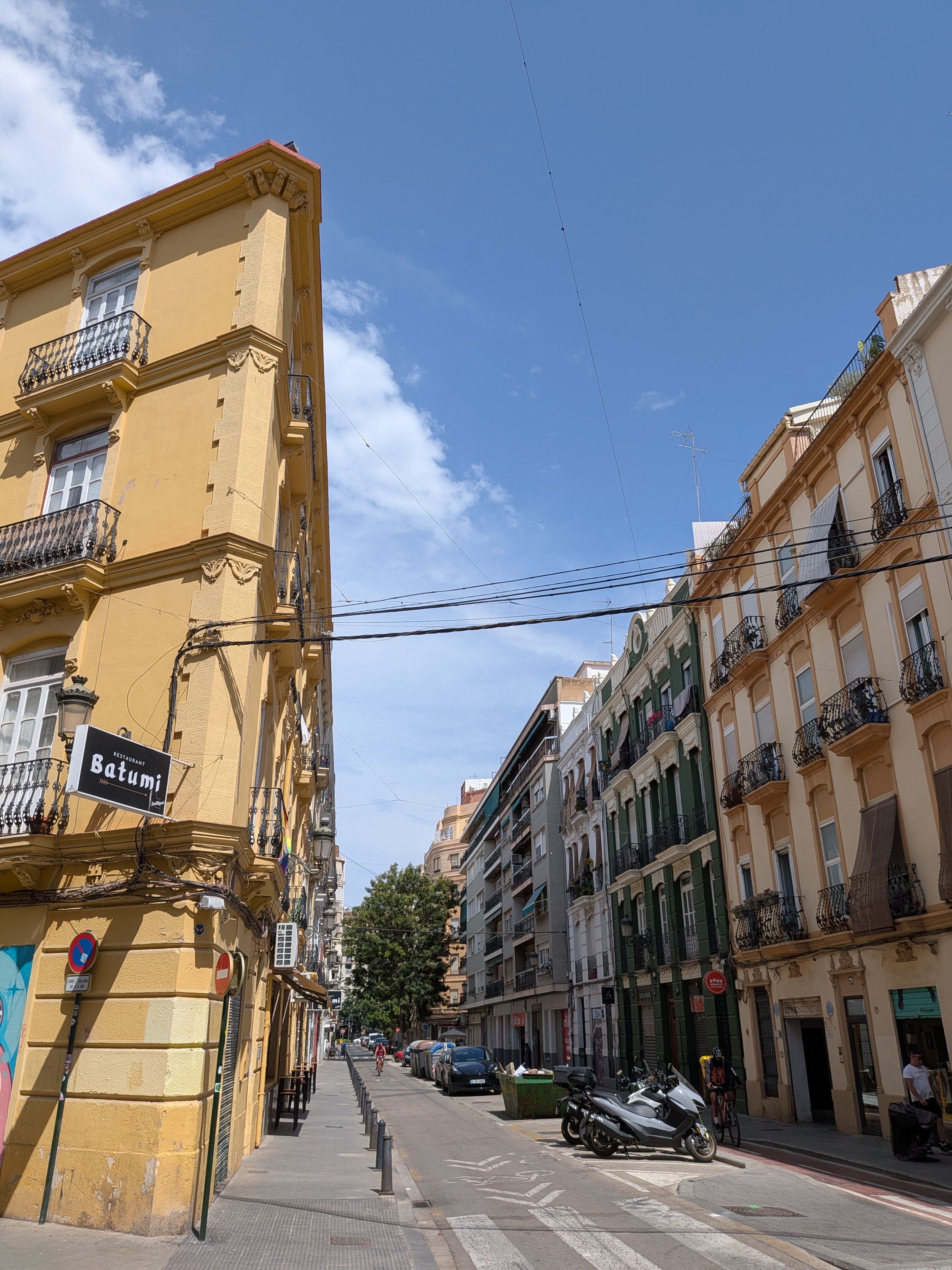
This process is well underway here in Valencia.
If I left Valencia tomorrow, I know exactly what would happen. I’d do to it what my mind already does to Los Angeles. I’d remember our daily coffee shop, the market, the rows of apartment buildings, and the routines that now feel ordinary because I’m living them.
I do this sometimes with Paris, and we only spent a month there.
That’s the condition that comes with being curious, eager, and enthusiastic about the world. Places get inside you and start becoming nostalgic before you even know it. Nostalgia is proof that you didn’t stay too long—that you didn’t render yourself stagnant—that you’re in the process of living a life that’ll go down as well-lived.
That’s the work.
Not to avoid nostalgia or to pretend the old life meant nothing. Not to keep moving every time a place becomes familiar or you experience discomfort. That would be a you problem, not a place problem. Because the lack of or, at least, less familiarity is a welcome feature—not an optional add-on—of moving abroad and doing other big things in life.
The work is to stay curious and introspective enough to know the difference between comfort and stagnation. To understand that the goal was never Los Angeles or Valencia or Paris or any other city as a final answer.
The goal is to keep choosing a life that keeps you engaged and on your toes.
I don’t miss Los Angeles.
I feel something stronger and stranger.
I feel nostalgia for a life that formed me, but no longer fit me — and I try not to confuse that ache with a reason to stop choosing the discomfort that keeps me moving forward.