

I think about gentrification a lot.
And I’ve come to a somewhat sad conclusion—it’s inevitable and it’s all relative.
When my daughter was about to be born in 2003, we moved into what was the gentrifying Mission District in San Francisco. We wanted to live there because it made sense logistically and as a neighborhood where you can access most of what you need without a car.
We rented a basement flat in a three-unit building for $1,875 a month.
We didn’t rent—say—a top-floor unit that would have gone for closer to $3,500 at the time.
We rented what was comfortably affordable.
Looking at the numbers today, the apartment we rented 23 years ago now goes for $3,649.
Increíble. The upper flats—based on my analysis—would go for between $4,800 to $6,000 a month.
I have been largely priced out of San Francisco’s Mission District.
Fast forward to 2018 and I moved to East Hollywood in Los Angeles—at the beginning of its still-evolving gentrification process.
Why? Because it was faster and cheaper to find something in my price range: A studio apartment for $1,300 a month. The same in West Hollywood would’ve been closer to work, but would have been more difficult to find and likely closer to $2,000.
Interestingly, that unit hasn’t increased that much in price. It’s now listed at $1,345. In fact, I think, after a rent increase or two, I was paying $1,345.
Whatever—the point is I made a choice based on several factors, including what I felt comfortable paying.
I’m not priced out of East Hollywood yet, but I wouldn’t be surprised if that happens someday.
Fast forward to 2025 and Valencia, Spain.
We made our decision to move to Valencia in 2023. Between the time of our decision and the move, rents increased by about 10.5%. Since we secured our long-term rental in February of 2025, they’ve increased a bit more, though it’s difficult to estimate by exactly how much.
We pay €1.500 for a two-bedroom in the heart of the neighborhood. Interestingly, we pay more than we did in Los Angeles where—thanks to strong rent control—our rent was $1,484 a month. Factor in the currency exchange and our rent in Valencia is $1,745.
We’re an odd case—we pay more for housing in Spain than we did in LA. For context—without rent control, market rate for that Los Angeles apartment would likely be around $3,000. An apartment that my wife rented before my time for nothing because it needed work in a central part of relatively tony LA.
She was making strategic choices about how to place herself in the best housing and geographic position possible at the same time as I was. And isn’t that what we all do—if we’re not made of money?
In a minute—a story that leads to the larger point.
But first…
If this kind of analysis is valuable to you—not just in this post, but throughout this newsletter—consider supporting the work.
Paid subscriptions are what keep this work alive. They help fund the reporting, the writing, the travel, and the time it takes to think through topics like this rather than recycle the same tired talking points everyone else uses.
You can also support the newsletter by opening a Wise account through my referral link. I’ve used Wise for years now to manage income the United States and Europe. It’s one of the few products I recommend because I actually use it.
Either way, thanks for reading.
I look back on and look at San Francisco now and it’s comical just how typical it really is when you consider it within the context of gentrification.
After my kid was born—in late 2003—we’d proceed down the hill on 21st Street toward Valencia (one of the main drags in The Mission is called Valencia) every single day. Me pushing the stroller.
One of the first times we did, this local eccentric—this was back when each neighborhood had a homeless person and an eccentric person or two, not as it is now with the city overrun by both. It used to be easy to determine who was who. You knew them by name and would often stop for a chat. Those days are long gone.
Anyway—
This guy—with long crazy hair who busked on the corner with an acoustic guitar—looked at my newborn and said, “Welcome to Earth, kid. Now let the pain begin.”
I just love telling that story, but I guess it pertains to the discussion—at least adjacently.
We’d turn the corner and—starting in May 2005—we became one of the first customers at a café called Ritual Coffee Roasters. It was a small place with friendly employees who liked to say hi to my daughter—and, to some extent, me. Now, Ritual is a staple in San Francisco—and it’s absurdly expensive.
This picture of the menu is from the Hayes Valley location in May 2025—
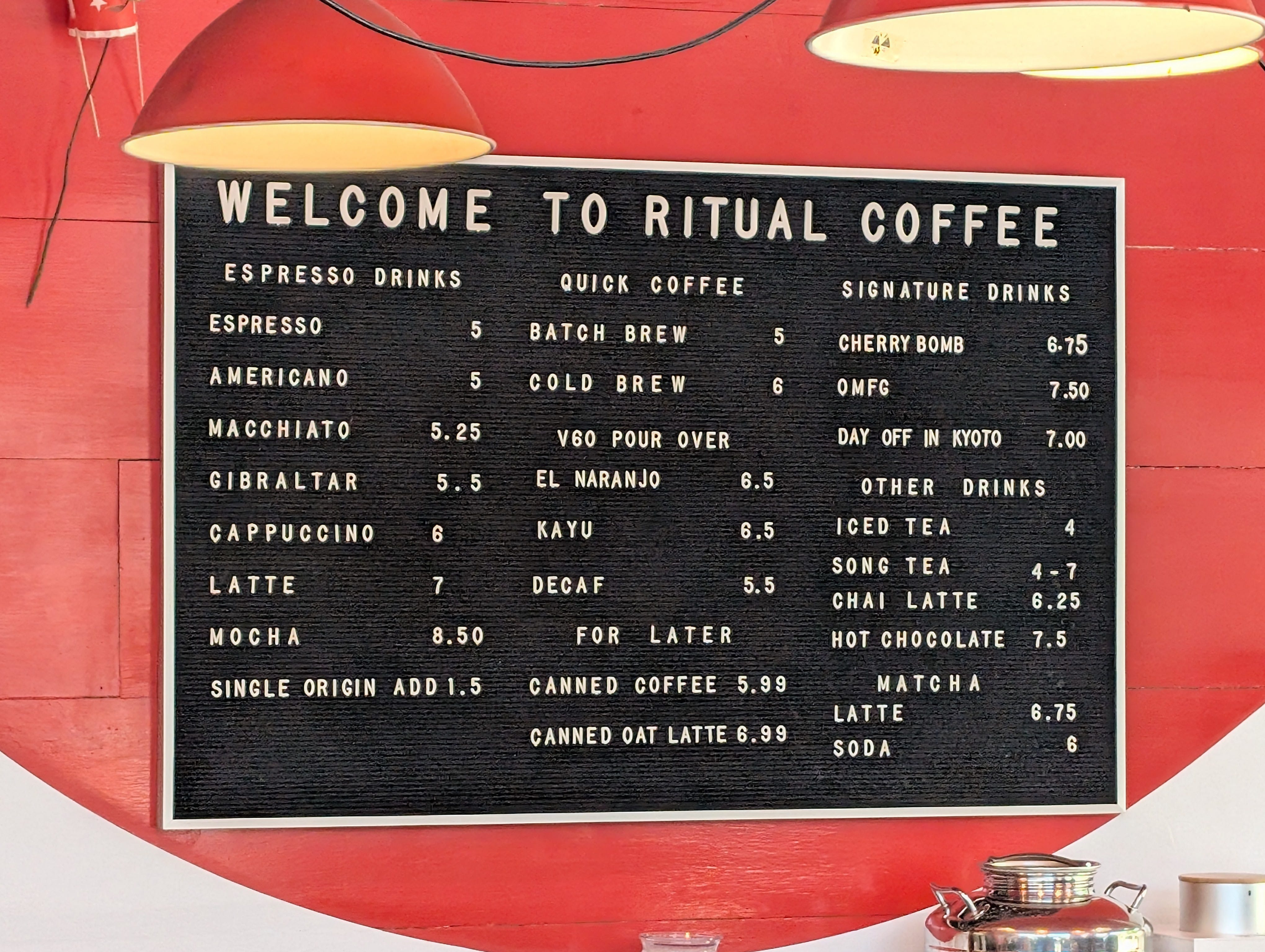
—I was paying about $3 for a cappuccino in 2005.
Ritual massively expanded that original Mission location. Now it basically looks like a fucking computer lab with tech people typing away. I think khakis and fleece hoodies have become the new dress code, though a few people behind the counter and Gen X guests with tattoos still remain.
Ritual is emblematic—a good symbolic foil—of the gentrification process we see around the world.
I wanted to ensure I wasn’t misremembering or romanticizing the past so I asked Google’s Gemini to check some things for me.
Here’s a summary of what it said:
Ritual Coffee Roasters first opened in May 2005 at 1026 Valencia Street in San Francisco’s Mission District.
Current Locations (4 Total)
After some recent closures (Haight Street closed in April 2025 and the Flora Grubb kiosk also closed), Ritual currently operates four established cafes, with a fifth location in the Financial District reportedly in the works as of early 2026.The Mission (Original): 1026 Valencia Street
Is it part of the gentrification process?
Yes, Ritual is frequently cited as a symbol of gentrification in the Mission.
Because it opened in 2005—just before the tech boom accelerated heavily—it is often viewed as a “pioneer” of the gentrification wave that transformed the neighborhood.“The Smell of Gentrification”: Local commentary has explicitly described the sensory shift in the Mission from “Mexican food” to “coffee and chai” as a marker of displacement, with Ritual’s arrival on Valencia Street being a key turning point.
Yes, the prices on that board represent the historical standard, but they have experienced a slight bump since then.
Here is exactly how the prices compare to what you would have paid at the original Mission District counter two decades ago:
1. Are the prices higher now?
Yes, but only slightly for standard drinks. Current menu pricing shows that most locations have adjusted upwards by about $0.25 to $0.50 on core milk-and-espresso beverages.
Cappuccino: Costs $6.25 - $6.50 (Up from $6.00 in May 2025)
Latte: Costs $7.25 - $7.50 (Up from $7.00 in May 2025)
2. What were you paying in 2005?
When Ritual first launched in May 2005 on Valencia Street, coffee prices were a stark contrast to today. You would have been paying roughly $2.75 for a cappuccino and $3.25 for a latte.
The deeper story here is that nearly every gentrifying neighborhood follows the same pattern. And you can’t stop it, you can only hope to contain it.
But it’s not the people’s job to deal with gentrification.
It’s not the job of the people at risk of being priced out—many of whom turn to activism, and understandably so.
It’s not the job of people making choices about where to live that work for them.
It’s not the job of landlords making rational and reasonable (as in, not skirting the rules to take long-term rentals off of the market) decisions in their own interest.
It’s not the job of commercial enterprises.
We have a place we go to a lot in our neighborhood here that’s creating a local mini-empire in Russafa—sort of like Ritual, but they’re moving beyond coffee. They do a nice job and keep their prices relatively normal, particularly on basic coffee drinks.
It’s the job of government.
But it’s a balancing act between macro-level economic prosperity and countless micro-level situations—some of which act in the aggregate.
Strong rent control is a must. So is housing construction at all price points. Regulation on national chains—especially American ones—is essential. I could go on, but it’s sort of pointless because we’ve been having the same conversation for decades.
Even in Spain—which as been far more progressive than even San Francisco—they’re not doing enough. I don’t want to say they can’t because—as Paris proved with cars—cities can do anything they want to do. It’s just easier to pay lip service, implement easy policy, and turn the other cheek.
At the micro level it all comes back to this—
Nobody moves somewhere thinking: “I’m here to participate in a long-term process of displacement.”
They move because they’re trying to improve their quality of life.
That’s what I was doing in San Francisco and East Hollywood.
That’s what my wife and I were doing when we chose Valencia.
And that’s what most people are doing—across the economic and ethnic spectrum.
We’re all born into situations. They change as we get older. Sometimes we will that change. At other times we have no impact whatsoever. It’s usually a mix of cards being dealt—and how.
Gentrification is less a story about individual people than it is a story about systems that governments either choose to manage or choose to ignore. The government’s job—or at least it should be—is to manage a society made up of all different types of people who have the same rights and many of the same—or, at least, similar—desires and aspirations.