

Something I wrote in 2024—before we moved—nicely sets the stage for today’s post. It goes a long way to illustrating what I mean when I say I don’t believe in the honeymoon period in the way that most of the world attaches it to moving abroad or doing other big things. I think many people accept the honeymoon period as fact because it’s an easy way to burst your bubble.
Well, you’re excited now, but that’s your emotion and excitement talking. Just wait until real life starts!
A day doesn’t pass in Spain without my wife and me reflecting on the fact—almost in disbelief—that we’ve been living here for 19 months after more than two years of planning. Or without one of us thinking to ourselves just how crazy it is that life has taken us here—as individuals and together. We’ve both packed quite a bit into our combined 98 years on the planet and our nearly six years together.
We’ve both been soberly assessing and anticipating every step of the process of making this move. Assessing the moments as we live them and anticipating what would come next and how it might feel.
For me, a constant has been a rejection of the typical way people frame the honeymoon period—which leads us to my thoughts from 2024:
I also feel like we have already lived the so-called honeymoon period and will hit the ground running (and living) right away in Spain…
Time has a way of creating certainty or leading you to realize that you really don’t want to do something as bad as you thought you did after all. Giving yourself time and space between making a decision you can still change and the point where you can’t or would have a harder time turning back is probably a good idea…
Time has mellowed out the excitement from post-vacation euphoria—which feels great so there’s no reason to suppress it—to something decidedly practical. To the notion that as much as we’re changing our lives, we’re really just enhancing—upgrading—our existing lifestyle and—subsequently—our quality of life.
Put another way, the more euphoria-like excitement came and went with the decision to move in the first place.
We didn’t move to experience a rush.
We moved to continue doing life in a place where we recognized the advantages immediately because we knew the environment we were leaving. Because that’s pretty much all we had to concretely compare it to—that and our accumulated knowledge of places, how they make us feel, and how we operated inside of them.
This is the critical part for anybody considering a move abroad or any other decision where people like to say the novelty will wear off. Such as retirement, starting a new job, or even—to reluctantly use another well-traveled phrase—following your passion.
Within the context of moving—
You arrive. Really, you know very little. All you have are your recent reference points. For us that was the United States and, specifically, Los Angeles. Then as that reference point fades and you accumulate experience and time on the ground in your new place, you know more and build new baseline reference points. So you start to expect more from your environment, especially when you see and experience what exists in your environment relative to what you see happening elsewhere as part of your accumulation of new experiences.
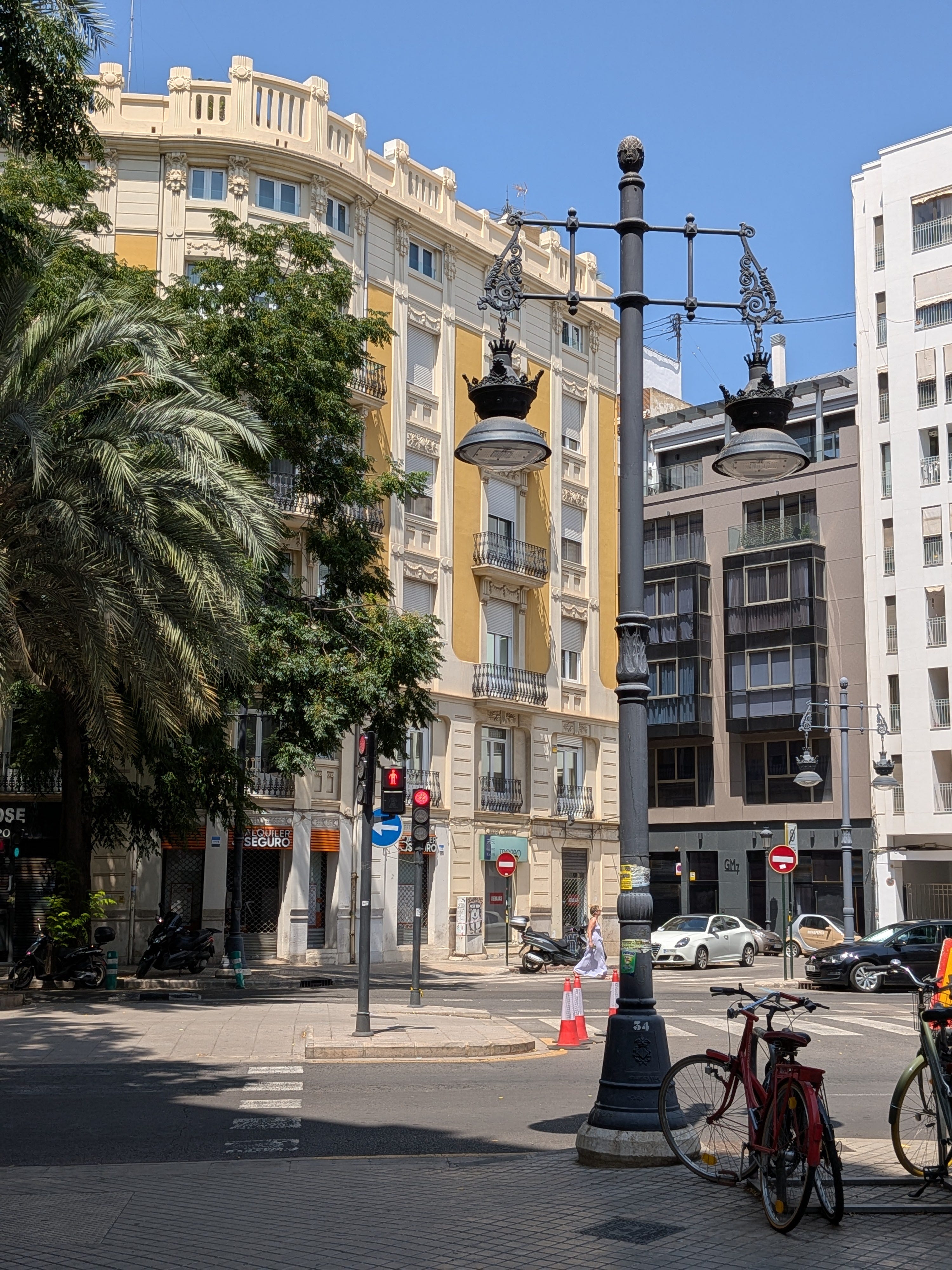
So, for me, seeing what Barcelona and Paris have done from an urban planning perspective and comparing them to similar things Valencia has done—and comparing that to the trajectory this city was on before a right-wing government took over and favored what amounts to pro-car actions and policies.
If you subscribe to the conventional honeymoon narrative, you might interpret any criticism of Valencia as evidence that my original enthusiasm was naïve. But recognizing that this city has work to do doesn’t negate any of the reasons why I love living here.
Just because it’s better as a city from urban planning, quality of life, and other standpoints than what you’re likely to find throughout most of the United States doesn’t mean it’s without problems or progress to make.
As time creates more space between where you came from (LA) and where you are now (Valencia), and you have new and diverse experiences (day-to-day living, seeing other places for the first time or from fresh perspectives), your old reference point fades. Somewhere around this juncture, I stopped comparing Valencia to Los Angeles and Spain to the United States as much as I used to and changed my baseline because my field of vision and experience expanded.
So I “complain” about things here more now. That’s not the part of the honeymoon narrative I reject. The recalibration is real.
It’s a recalibration in which ‘better than the United States’ stops being a sufficient or helpful standard. When you see how things are done elsewhere in relation to where you came from, hopefully you evolve to expecting the place you live in now to meet its own possibilities. You don’t sit around the table with other “expats” bemoaning “bureaucracy,” complaining because the clerk didn’t speak English, or noting where you can find Philadelphia Cream Cheese. You’re life exists in your new setting.
You see Valencia’s incredible bicycle infrastructure. Then you see that progress stunted at the same time as you witness more great strides in Barcelona and Paris. Criticism becomes something you contribute from inside your life here, not commentary delivered from an outside perspective living in the past that has very little to do with the present.
You know you’re becoming part of a place when you stop treating its problems as local color and start caring whether they get fixed.
To me, this is integration.
It’s not the moment when everything feels completely familiar—because it still doesn’t. It’s the moment when the future of a place begins to matter to you. When you start to have a dog in the fight because you’re walking and riding your bike on these streets and sitting in these plazas and supporting these local businesses. And doing this life right here and right now.
When my wife read an early version of this, she told me I was basically describing the end of the honeymoon period while insisting I don’t believe in it.
Semantically, she might be right.
I don’t necessarily reject the process people are trying to describe. Of course familiarity replaces novelty. You accumulate experience, notice problems you couldn’t see at first, and develop a more complicated relationship with the place where you live.
What I reject is the conclusion often assumed in the cliché—that your original excitement was mostly naïveté and reality eventually arrives to correct it.
So, the process is real. It’s the meaning people attach to it that I reject.
I’ve been through this process many times throughout my life. When I lived in San Francisco, I loved it there. I would defend that city against any and all criticism. I rode my bike with almost as much zest there as I do here. But I also held an ambitious vision of what was possible in that city based on what I was studying and seeing happen around me and around the world. I loved the place, but I knew it could be better and I wanted it to be better.
Still, every night when I go to bed in Spain, I can’t wait to wake up in the morning.
I love walking out our front door and having our day. Going to the market, sitting in the plaza, taking walks with my wife, and cycling across the city. Working on our respective projects and enjoying a neighborhood where I can see the urban planning principles I’ve been studying and writing about for three decades happening in practice.
Life here feels ordinary without feeling any less incredible—which was the goal all along.
I also love being in the middle of an ongoing urban transformation, given I have a tendency to view things through the lens of city planning. Watching Valencia decide what kind of city it wants to become—and witnessing the conflict, contradictions, and regression happening amid what has otherwise been considerable progress.
If we lived in Paris, I’d have different concerns and criticisms. Some would probably be the same. Because no city is finished and no place worth caring about is without problems. Paris’s recent urban transformation should be a model for cities around the world, but even that praise doesn’t mean the place is immune to criticism and concern.
All of this is part of what makes city living so exciting to me.
As I said the other day:
The allure of suburbia often focuses on the elimination of these so-called urban stressors. But it also removes a source of intellectual and psychological stimulation from your life that I don’t think people—particularly in the United States, but also around the world—fully appreciate. I mean, even in SF and LA, I took “the good with the bad” in part because of desensitizing yourself so you can keep a smile on your face, but also because—what’s the alternative?
Every day, you can touch, feel, and experience the things that matter. You can see how political decisions alter the streets, plazas, and bike lanes. Cities offer a dynamic sensory experience that prototypical suburbia simply can’t match in quantity or depth.
After living the problems and limitations of Los Angeles and the United States, I can now see a world I could only imagine from there. Now that world in Spain is my day-to-day, so I’m immersed in the same type of thinking I’ve spent the last 25 years of my life doing—imagining how my new baseline urban environment could be better, even if it’s already pretty damn good. Even if it’s the best one I’ve ever called home.
Nothing I originally loved about this life and place has disappeared. What changed was my ability to judge Valencia against something more meaningful, present, and urgent than the United States.
At a dinner here in Switzelrand last week, my dinner guest asked me why whether, now that my wife and I had "done South Africa", we wouldn't move on to the next place.
Well, we have "done" the first five months, and we are going back for more. We have a five-year plan. We are not aiming ot just tick items off a list.
I told my dinner guest that our next step was to reap something from those first five months; more routine, meet more people.
I have been MIA for what I have now realized is near 8 months. Death can blindside a person. Make it two in two weeks of each other and time slipped away from me.
Now I’m trying to catch up with Never Retire and How It Works.
I noticed the change from comparisons, to finding the place to call home (naturally and authentically) and now you just get to live it.
In regard to “never retire,“ has that changed at all? Meaning, are you making it without struggling at all financially? Do you still save the same way with your banking? Do you pay for medical in Spain, or is it through your taxes now?
If you have written about this already, I apologize. And you can please point me in the direction of what articles to read. :)