

A quick note about something I’ve been working on.
In addition to what I write here, I’ve spent the better part of the last several years covering exchange-traded funds (ETFs) for financial publications in the United States and, since moving to Spain, Europe.
I’m bringing that work together in a new Substack called WTF Is an ETF?, which debuts on January 4. We’ll look inside ETFs to see what investors actually own, how to diversify without inadvertently doubling down on the same stocks, and how to put together a portfolio of ETFs that complement one another.
And because I think of ETFs much like I think of the cassette mixtapes I made growing up and the playlists I make and listen to now, I’m going to construct actual music playlists inspired by the ETFs we analyze, applying some of the same selection criteria fund managers and index providers use to select stocks. We’ll explore the art of putting together an investment portfolio alongside the art of making a great playlist.
Much thanks to the great Kevin Alexander for inspiration on this idea.
Whether you’re relatively new to investing, a seasoned DIY investor, or a financial advisor, I hope you’ll subscribe ahead of the January 4 debut.
Now let’s talk about cities…


To call it brainwashing almost sells short the impact of what has happened over decades in the United States.
Think about it.
A large swath — if not a sizable majority of Americans — believe the inextricably-linked narratives that people in cities “live on top of one another” and that a better life awaits in suburbia. That — unless you’re a fringe case, maybe ultra-rich or dirt poor—you’re struggling or settling if you live in the city.
If you’re an American — or a consumer of American bullshit — it can be difficult to escape the cult of suburbia.
When talking specifically about city life — as we do here — misconceptions about density sit at the heart of the conversation.
For many Americans, skyscrapers have become the symbol of the city. They’re meant to project power and dominance. This limited, self-serving conception of the city confuses density with building height and helps perpetuate the idea that living close to other people is something to resist at all costs. Density is almost always framed as something people must endure rather than something they can benefit from.
But that’s not the case at all. I live in a Spanish neighborhood that’s about as dense as Manhattan and I don’t feel crushed or cramped by humanity. In fact, it’s quite the opposite. Density permits the type of day-to-day life that — in an odd contradiction — the United States has turned into a novelty.
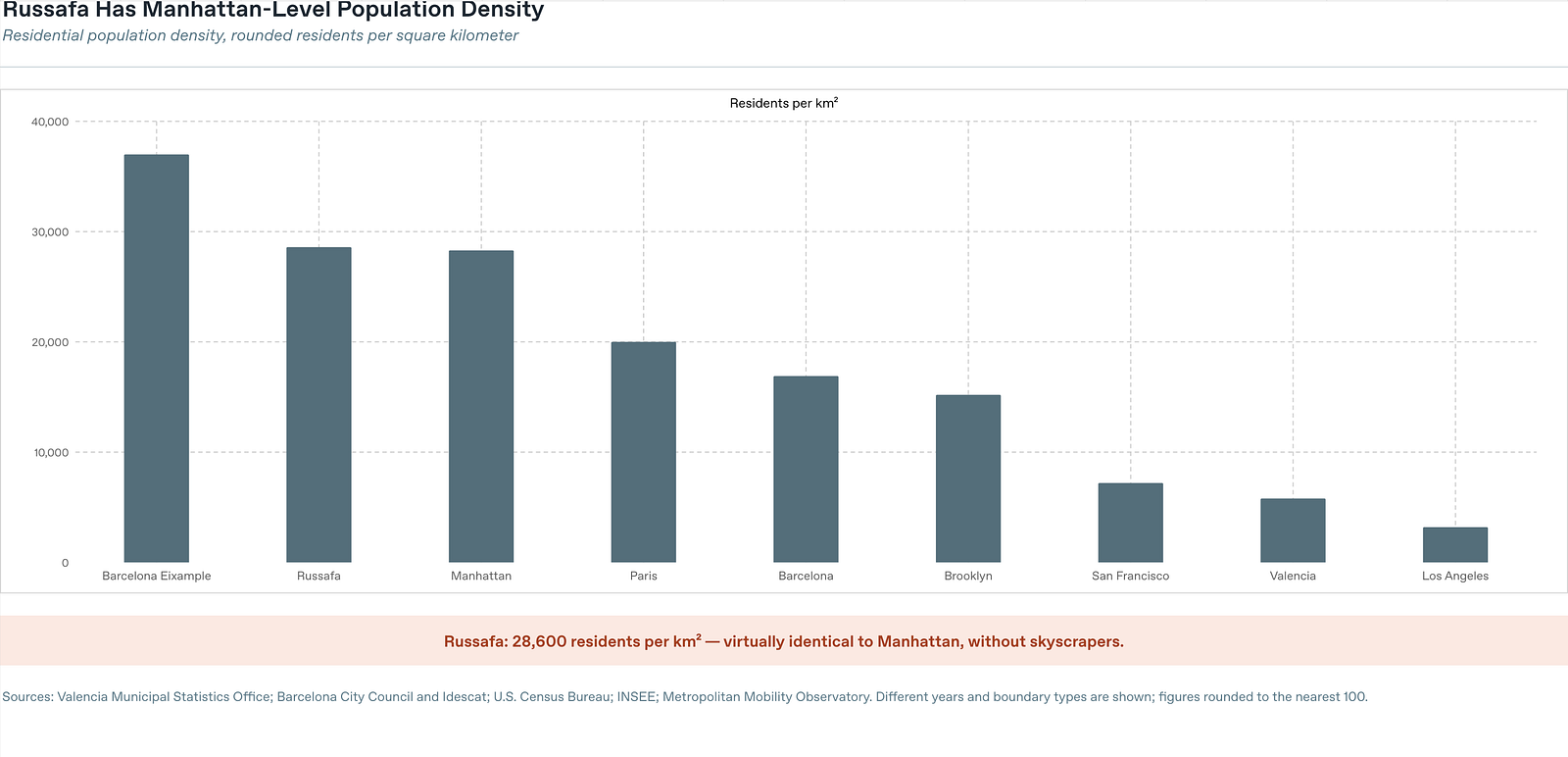
That graphic compares my neighborhood — Russafa in Valencia, Spain — with the core of Barcelona, Manhattan, Paris, Barcelona citywide, Brooklyn, San Francisco, Valencia citywide, and Los Angeles.
Consider the daily life density makes possible here.
I live no more than one-minute — on foot — away from the municipal market. A vast majority of my neighbors live no more than ten minutes away. Same applies for dozens of supermarkets, bodegas, fruterías, and other specialty food/drink shops. Same applies for literally hundreds of restaurants, bars, and cafés. And you name the service — it’s most likely within walking distance.
I don’t own a car. I don’t need one. And I never find myself wishing I had one.
All of this is made possible, in large part, due to a high concentration of people living in close proximity to one another. And the really cool thing is that, in a city like Valencia, with a population of under one million, you can have a neighborhood that’s every bit as good, if not better than iconic neighborhoods in places such as Manhattan.
All these people living so close together make everyday life feel less complicated, not more.
This isn’t just me bragging about where I live — only a little.
This is important stuff to understand and consider for societies around the world.
First, don’t confuse crowding — or overcrowding — with high density. They’re not the same things. Density simply quantifies how many people live in a particular area. It doesn’t, on its own, tell us anything about living conditions, access to public space, the mix of shops and services, or whether daily errands require a car.
Second, density done well produces places where people converge. This has always been the dream and reality of the city. Different types of people from different walks of life working in concert to drive economies and create social and creative opportunities that are much harder to sustain in low-density suburbia.
This part is particularly vital, especially for young people. More businesses, more opportunities to find work, meet people, change direction, try something new, and figure out what you want to do with your life. Cities provide opportunities for economic and creative experimentation that become much harder to find when everything is spread out.
Of course, housing costs and gentrification increasingly shut people out of these opportunities. But that’s an argument for making more places like this accessible to more people, not rejecting the density that helps create them.
The United States actively conspires to promote suburbia as the ideal, then turns around and celebrates places that resemble the very urban environments we’ve rejected. There are actual lists on social media that promote places that will make you “feel like you’re in Europe.” Solvang, California, comes to mind. It’s a real town with genuine Danish heritage, but also a tourist destination where people drive to experience a few blocks of European-style streets, shops, and cafés.
Then there are the manufactured sites such as Downtown Disney, sterile pedestrian-only shopping streets, and even actual main streets within towns and cities. They’re different places, but they reflect the same fascination with urban environments experienced primarily as destinations rather than places to conduct everyday life. Fake-ass or second-class environments Americans fetishize as novel. A place to visit, photograph, and get in your steps before hopping back in the car and driving home.
Many Americans celebrate the appearance of urban life while resisting the density and mixing of uses that allow it to function as actual everyday life.
And herein lies both the tragedy and miracle of the United States.
Cities take a lot of shit. Some of it well-deserved, much of it pathetic right-wing nonsense, and many of the problems are made worse by decades of fiscal policy that flat-out favors the suburbs and car-centric development. Yet, for all they’re up against, dense urban development remains incredibly productive.
Urban economics firm Urban3 found that downtown Redlands, California, generates 6.5 times more property and retail tax revenue per acre than a sprawling shopping center. A Smart Growth America study found that compact development generates roughly 10 times more tax revenue per acre than conventional suburban development, while costing 38% less in upfront infrastructure and 10% less in ongoing public services. So density doesn’t just create better places to live. It makes much better financial use of the land and infrastructure cities already have to pay for.
Imagine how great American cities could become if the nation took urban living more seriously.
It’s a miracle that American cities have remained as vibrant and economically productive as they have, given everything they’re up against. It’s a national tragedy that we keep forcing them to contend with problems we know how to fix. More housing, more mixed-use development, better public transportation, and fewer barriers to living without a car would go a long way toward making cities more vibrant, accessible, and inclusive.
We shouldn’t need to constantly defend the existence of and urgent need for thriving cities or explain why people choose to live in them.
Maybe it’s time to question the suburban experiment instead — and the disproportionate amount of space, money, and infrastructure we’ve devoted to sustaining it.