

This past weekend was one of those nights when I genuinely wish every American who reads my work could have been walking beside me in Valencia. Not because it was extraordinary, but because it was so normal—and that’s the part most people in the U.S. can’t quite grasp.
Valencia runs at a level of calm, density, public life, and basic human functionality that Americans think they understand until they consider it within the context of their own experience.
They hear “walkable” and imagine a farmer’s market. They hear “lively” and picture a street fair with police barricades and a five-page list of rules.
But here, the baseline—the default—is something Americans don’t have a reference point for. I’m not romanticizing it. I’m not selling a dream. I’m telling you, as someone who lived 49 years in the United States: this place operates on a frequency the U.S. doesn’t even have the capacity to receive.
If you want the longer version of what I mean—I talked about this in a recent YouTube interview with the great Shawn Forno. But keep reading and watch the video after, because what happened Saturday night is the real story and real-time context.
Last Saturday, my wife and I were walking around Valencia’s city center and immediately felt something different: more people than usual, an elevated energy in the air. The type of energy that you feel when a massive crowd forms—by coincidence, small groups coming together, independent of one another, to create an urban sum greater than its parts.
Then we realized—several streets were completely closed. Not blocked off for an event. Not full of cops or cones. Just… people. Thousands of them. No cars anywhere.
At first, we thought it was spontaneous. Turns out it was intentional. The city preemptively closed the center to cars because they expected crowds.
Let me say that again: in anticipation of people enjoying their city, Valencia removed the cars.
It was warmer than usual, holiday festivities had begun, and the iconic Valencia Marathon was happening the next morning. So the city turned Saturday into Supersábado.
And instead of tension that all too often spirals into chaos and ends up on the local evening news, the city just worked. It felt alive in a way that’s simply impossible in most American cities because the systems—human systems, the culture, the infrastructure—don’t allow it.

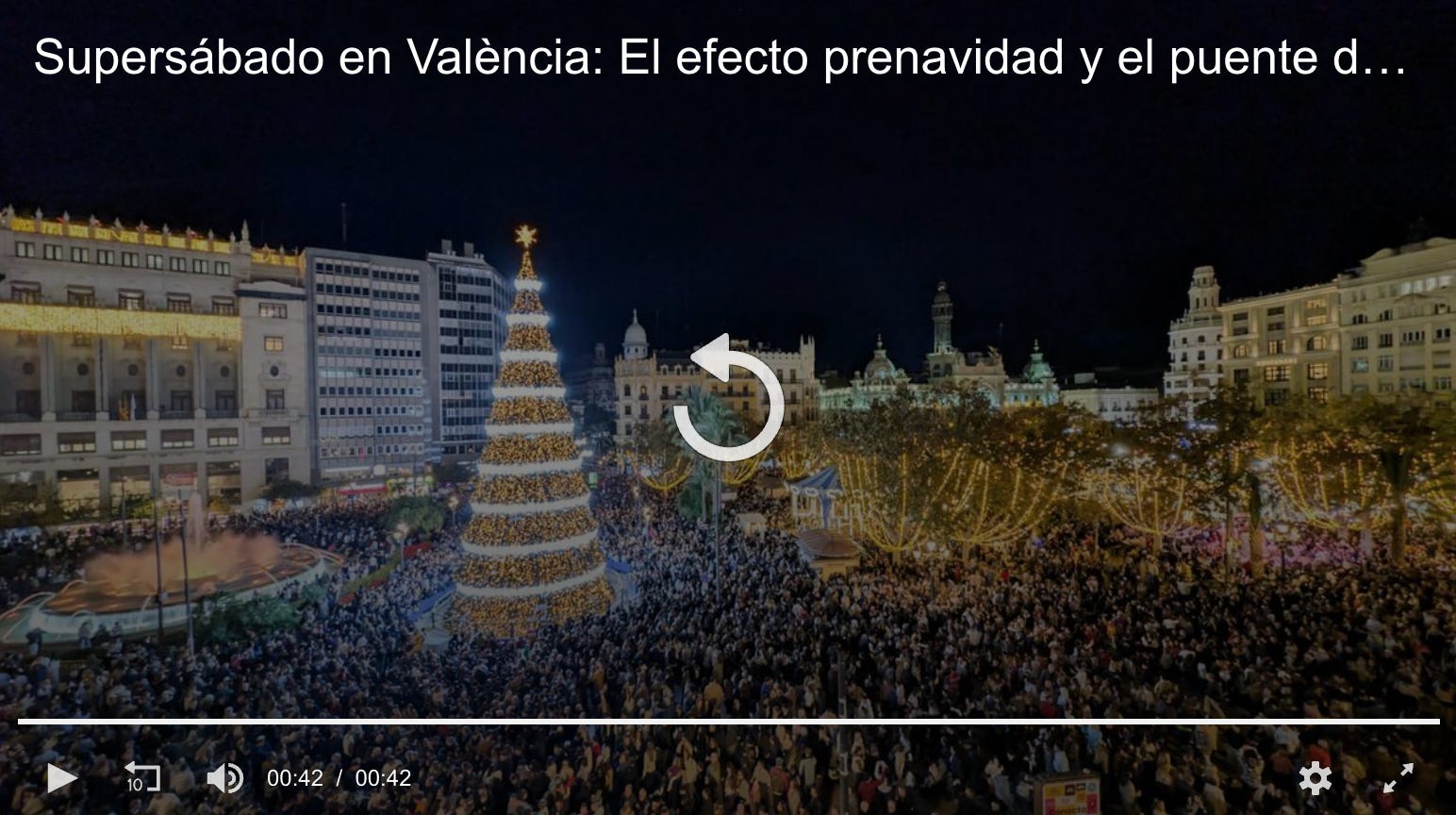
What struck me wasn't as much the size of the crowd, but the mood of the crowd. This happens almost every time people gather here—planned or spontaneously. And it’s basically just an amplification of the way the streets feel with fewer people amid the rhythm of daily life here.
You know that feeling you get in the U.S. in the rare cases that a large crowd forms in public space? That everyone’s jockeying for position (because they are). That if you bump into the wrong person, they might take it the wrong way (because more than a few will). That feeling doesn’t exist here.
Nobody was honking from a car trapped where it shouldn’t have been because the city hadn’t bothered to plan. There were no cops barking orders, no sense that something could go down at any minute (because it could and often does).
Just people. Walking. Talking. Enjoying the city. Moving with and around each other the way humans do when they’re not marginalized by traffic flow or squeezed into whatever narrow space cars leave behind.
Thanks largely to American car culture—and the larger attitude it facilitates and proliferates—the exact same scenario in the United States would’ve been unthinkable.
If this many people showed up anywhere unexpectedly in an American city, you’d immediately feel the tension. Drivers furious about delays. Police mobilizing to “control the situation.” There’d at least one verbal altercation. Maybe one or more would turn slightly or full-on physical. People—especially car drivers—melting down because the city momentarily stopped revolving around their personal convenience.
In the U.S., (for reasons bigger than the tame shit I mention here) crowds create fear. In Valencia, crowds create atmosphere. They remind you that cities in the U.S. have failed miserably to put people first. And it shows in the culture, in a day-to-day that feels more like survival than anything even resembling a decent quality of life.
But the difference isn’t about some vague cultural quirk. It’s infrastructure. It’s design. It’s political will. It’s systems.